 Subscribe
E-list # 210
New Arrivals: Publisher's Files
In the late 1980s and early 1990s, publishing underwent a series of changes that consolidated and internationalized the industry. For one publisher, this involved moving offices in downtown Boston, which in turn involved a culling of old files. One intrepid employee, watching literary history facing disposal, retrieved as much as he could that he thought had literary value. After he died last year, we were asked by his family to help find suitable homes for the papers he saved: we offer them here, with respect to the writers and gratitude to Alan Andres, for preserving them. These are unique records of a bygone publishing era, each a footnote to the authors' larger bodies of work, and a coda to the impact their art has had on our culture.
1.
ADAMS, Ansel
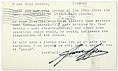 1968. A typed postcard signed written to the copyright department at Houghton Mifflin, apparently in response to the question of the disposition of photographic plates for the 1950 edition of Mary Austin's The Land of Little Rain (which featured 48 photographs by Adams). Adams says, in part, "As this item had some past history (and perhaps some future history!) I have written Mr. Paul Brooks - your vice-President) [sic] and asked some questions which would, or could, influence disposition of the plates." Signed by Adams. We do not believe that the plates received any future use. Postal markings across the upper half of Adams' text; near fine.
[#036665]
SOLD
1968. A typed postcard signed written to the copyright department at Houghton Mifflin, apparently in response to the question of the disposition of photographic plates for the 1950 edition of Mary Austin's The Land of Little Rain (which featured 48 photographs by Adams). Adams says, in part, "As this item had some past history (and perhaps some future history!) I have written Mr. Paul Brooks - your vice-President) [sic] and asked some questions which would, or could, influence disposition of the plates." Signed by Adams. We do not believe that the plates received any future use. Postal markings across the upper half of Adams' text; near fine.
[#036665]
SOLD
2.
ADAMSON, Joy
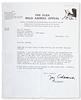 1971. The author of Born Free here offers her opinion on the book Innocent Killers by Jane Goodall and Hugo Van Lawick to the book's publisher, opining that "it would have been better to concentrate on one species at a time, instead of undertaking too many animals in different places, and with too many people involved. I also think it is a mistake to have to keep up family obligations when one is doing research on animals." Written on Elsa Wild Animal Appeal airmail stationery. Signed by Adamson. Her books about raising an orphaned lion cub, and following up with its offspring in later years were bestsellers in the 1960s and made into an academy Award-winning film. They helped change the perception of the relationship between humans and "wild" animals, and the need for conservation -- as Jane Goodall's books did over her lifetime and beyond. Folded for mailing; near fine.
[#036666]
SOLD
1971. The author of Born Free here offers her opinion on the book Innocent Killers by Jane Goodall and Hugo Van Lawick to the book's publisher, opining that "it would have been better to concentrate on one species at a time, instead of undertaking too many animals in different places, and with too many people involved. I also think it is a mistake to have to keep up family obligations when one is doing research on animals." Written on Elsa Wild Animal Appeal airmail stationery. Signed by Adamson. Her books about raising an orphaned lion cub, and following up with its offspring in later years were bestsellers in the 1960s and made into an academy Award-winning film. They helped change the perception of the relationship between humans and "wild" animals, and the need for conservation -- as Jane Goodall's books did over her lifetime and beyond. Folded for mailing; near fine.
[#036666]
SOLD
3.
ASIMOV, Isaac
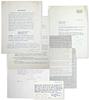 1962-1983. An archive of correspondence (five typed letters signed; one typed note signed; one typed postcard signed; and a typed letter and an autographed card written by Asimov's wife, Janet, each with a signed postscript from Asimov); along with a completed author questionnaire, signed by Asimov; and a two-page essay typed and signed by Asimov on the subject "Books and libraries: what they can contribute to continuing self-education," which Asimov submitted for 1963 Library Week's "Famous Bylines," although we can find no record of its ever having been published. The author questionnaire (1962) comes with a disclaimer about how much Asimov hates these questionnaires (he mentions this 4 times), but he has typed his answers over 7 pages: places lived; education; occupations; hobbies; writing routines; favorite modern writer (himself); writing advice; promotional ideas; etc. The (apparently unpublished) essay praises the public library and the concept of a lifetime of ongoing education. Asimov's letters transmit this essay; transmit the manuscript of his wife's novel; thank his publisher for a party ("a high point of my life"); and in the later years bemoan the fading from print several of his early titles (such as An Easy Introduction to the Slide Rule). Additionally included here is a typed postcard signed by Ray Bradbury (1969), explaining that the Asimov galleys will not reach him in London, and a typed letter signed from Arthur C. Clarke (secretarially typed, but signed by Clarke), also from 1969, in which Clarke makes a stated exception to his rule of not commenting on books by praising both the book Opus 100 and Asimov himself, as being not just a national resource, but a "global one, at least." The presence of Bradbury and Clarke in this archive comprises a sci fi "Big Three" -- who collectively wrote several of the most important science fiction novels of the 1950s and beyond -- from Asimov's Foundation Trilogy, to Clarke's 2001: A Space Odyssey to Bradbury's Fahrenheit 451 and The Martian Chronicles. The 7-page questionnaire and 2-page essay on libraries comprise significant unpublished and unknown writings by Asimov, who wrote or edited over 500 books in his career. The lot is near fine.
[#036667]
SOLD
1962-1983. An archive of correspondence (five typed letters signed; one typed note signed; one typed postcard signed; and a typed letter and an autographed card written by Asimov's wife, Janet, each with a signed postscript from Asimov); along with a completed author questionnaire, signed by Asimov; and a two-page essay typed and signed by Asimov on the subject "Books and libraries: what they can contribute to continuing self-education," which Asimov submitted for 1963 Library Week's "Famous Bylines," although we can find no record of its ever having been published. The author questionnaire (1962) comes with a disclaimer about how much Asimov hates these questionnaires (he mentions this 4 times), but he has typed his answers over 7 pages: places lived; education; occupations; hobbies; writing routines; favorite modern writer (himself); writing advice; promotional ideas; etc. The (apparently unpublished) essay praises the public library and the concept of a lifetime of ongoing education. Asimov's letters transmit this essay; transmit the manuscript of his wife's novel; thank his publisher for a party ("a high point of my life"); and in the later years bemoan the fading from print several of his early titles (such as An Easy Introduction to the Slide Rule). Additionally included here is a typed postcard signed by Ray Bradbury (1969), explaining that the Asimov galleys will not reach him in London, and a typed letter signed from Arthur C. Clarke (secretarially typed, but signed by Clarke), also from 1969, in which Clarke makes a stated exception to his rule of not commenting on books by praising both the book Opus 100 and Asimov himself, as being not just a national resource, but a "global one, at least." The presence of Bradbury and Clarke in this archive comprises a sci fi "Big Three" -- who collectively wrote several of the most important science fiction novels of the 1950s and beyond -- from Asimov's Foundation Trilogy, to Clarke's 2001: A Space Odyssey to Bradbury's Fahrenheit 451 and The Martian Chronicles. The 7-page questionnaire and 2-page essay on libraries comprise significant unpublished and unknown writings by Asimov, who wrote or edited over 500 books in his career. The lot is near fine.
[#036667]
SOLD
4.
BALDWIN, James
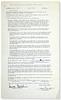 1964. A one-page contract signed by Baldwin allowing for his story "This Morning, This Evening So Soon" to appear in Fifty Best American Short Stories 1915-1966. Baldwin's story first appeared in the Atlantic Monthly in 1960. Legal size paper, folded unevenly in fourths, and with one corner crease; very good.
[#036668]
SOLD
1964. A one-page contract signed by Baldwin allowing for his story "This Morning, This Evening So Soon" to appear in Fifty Best American Short Stories 1915-1966. Baldwin's story first appeared in the Atlantic Monthly in 1960. Legal size paper, folded unevenly in fourths, and with one corner crease; very good.
[#036668]
SOLD
5.
BASS, Rick and SWIFT, Graham
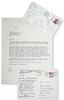 1988-1991. The file contains one typed letter signed and two autograph postcards signed from Bass, and two autograph postcards signed from Swift. Note that these letters are not to each other, but to their publisher about each other. Swift begins by saying he's impressed with Bass's The Watch and is forwarding it to his UK publisher, Penguin. (He's also on his way to Stockholm and Paris to publicize Out of this World, and hoping to meet Don DeLillo.) The second Swift note, a card, says Penguin "has bought Rick Bass for UK publication." Bass then types to his publisher with thanks for initiating the sale and expressing indirect gratitude to Swift. "I mean, how do you thank someone for that?...one morning I wake up with no English contract in sight, I'm out chopping wood, minding my own business, and the next day this deal floats down from heaven..." Bass also expresses some problems with his new electric typewriter and some dread about leaving Montana to teach in Texas, and he reports his social event for the week was a haircut. A postcard follows, which shows Bass with his wife and some fish he's caught (there is a publisher's notation here to add his "girlfriend's" name to Bass's rolodex card). There are several retained copies of letters to the two included, the most humorous of which is the publisher telling Swift that the Penguin offer "will allow [Bass] to come down from the ranch every once in a while and buy groceries instead of having to trap and kill them himself." A final, 1991 postcard from Bass agrees to the removal of a comma and adds (cryptically), "I still don't think my 'challenge' would make big stores drop the book, & might lure a bastard or 2 into picking it up." The lot is fine. An interesting glimpse of the informal "grapevine" of publishers and writers helping to get a young writer published and established. Nearly 40 years later, Bass is still living in the Montana wilderness and publishing books, mostly on the environment, to substantial critical acclaim. Swift, who was also a young writer at the time of these notes, not yet 40, is now something of an eminence grise of English letters.
[#036669]
SOLD
1988-1991. The file contains one typed letter signed and two autograph postcards signed from Bass, and two autograph postcards signed from Swift. Note that these letters are not to each other, but to their publisher about each other. Swift begins by saying he's impressed with Bass's The Watch and is forwarding it to his UK publisher, Penguin. (He's also on his way to Stockholm and Paris to publicize Out of this World, and hoping to meet Don DeLillo.) The second Swift note, a card, says Penguin "has bought Rick Bass for UK publication." Bass then types to his publisher with thanks for initiating the sale and expressing indirect gratitude to Swift. "I mean, how do you thank someone for that?...one morning I wake up with no English contract in sight, I'm out chopping wood, minding my own business, and the next day this deal floats down from heaven..." Bass also expresses some problems with his new electric typewriter and some dread about leaving Montana to teach in Texas, and he reports his social event for the week was a haircut. A postcard follows, which shows Bass with his wife and some fish he's caught (there is a publisher's notation here to add his "girlfriend's" name to Bass's rolodex card). There are several retained copies of letters to the two included, the most humorous of which is the publisher telling Swift that the Penguin offer "will allow [Bass] to come down from the ranch every once in a while and buy groceries instead of having to trap and kill them himself." A final, 1991 postcard from Bass agrees to the removal of a comma and adds (cryptically), "I still don't think my 'challenge' would make big stores drop the book, & might lure a bastard or 2 into picking it up." The lot is fine. An interesting glimpse of the informal "grapevine" of publishers and writers helping to get a young writer published and established. Nearly 40 years later, Bass is still living in the Montana wilderness and publishing books, mostly on the environment, to substantial critical acclaim. Swift, who was also a young writer at the time of these notes, not yet 40, is now something of an eminence grise of English letters.
[#036669]
SOLD
6.
BELLOW, Saul
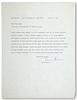 1982. Bellow submits a full paragraph in praise of the journalist Sydney Harris, who has "sometimes reminded me of Lewis Carroll's forty maids with forty mops trying to clean everything up. Good writers are like that, wielding their mops against fatality with their last strength." Signed, "Saul Bellow." Bellow's full paragraph appeared on the jacket of Harris' collection Pieces of Eight. Bellow won the Nobel Prize for Literature in 1976 and his endorsement of others' writings was highly valued as a result. Folded for mailing; near fine.
[#036670]
SOLD
1982. Bellow submits a full paragraph in praise of the journalist Sydney Harris, who has "sometimes reminded me of Lewis Carroll's forty maids with forty mops trying to clean everything up. Good writers are like that, wielding their mops against fatality with their last strength." Signed, "Saul Bellow." Bellow's full paragraph appeared on the jacket of Harris' collection Pieces of Eight. Bellow won the Nobel Prize for Literature in 1976 and his endorsement of others' writings was highly valued as a result. Folded for mailing; near fine.
[#036670]
SOLD
7.
BENCHLEY, Peter
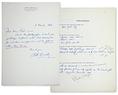 1964. An author questionnaire submitted by Benchley to Houghton Mifflin around the time of his first book published for adults, the travel memoir Time and a Ticket. (His children's book, Jonathan Visits the White House, was published the same year.) Benchley skips many of the questions but provides demographic details including education, cities of residence, and occupations; he explains when he started writing and when he wrote this book; he names his favorite writers (E.B. White, Truman Capote, and John Steinbeck), and he lists Steinbeck as someone who may be interested in helping to promote the book. Included is an autograph note signed by Benchley assigning any photography credits to Jill Krementz. Most all pages have in-house publisher markings for follow-up actions. Near fine. Benchley achieved pop culture immortality with his 1974 novel Jaws, which sold millions of copies and was the basis for the 1976 movie, which was the first blockbuster film that Steven Spielberg directed.
[#036671]
SOLD
1964. An author questionnaire submitted by Benchley to Houghton Mifflin around the time of his first book published for adults, the travel memoir Time and a Ticket. (His children's book, Jonathan Visits the White House, was published the same year.) Benchley skips many of the questions but provides demographic details including education, cities of residence, and occupations; he explains when he started writing and when he wrote this book; he names his favorite writers (E.B. White, Truman Capote, and John Steinbeck), and he lists Steinbeck as someone who may be interested in helping to promote the book. Included is an autograph note signed by Benchley assigning any photography credits to Jill Krementz. Most all pages have in-house publisher markings for follow-up actions. Near fine. Benchley achieved pop culture immortality with his 1974 novel Jaws, which sold millions of copies and was the basis for the 1976 movie, which was the first blockbuster film that Steven Spielberg directed.
[#036671]
SOLD
8.
BERRY, Wendell
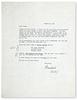 1963. A typed letter signed by Berry, asking, presumably, his agent to hold off on trying to place his novel's chapters with a magazine until the novel is nearer to completion. He also asks for copies of his first novel, Nathan Coulter, published in 1960, as "Now and then I get a chance to give one to somebody who can read." Marked, slightly, by the recipient. Near fine.
[#036672]
SOLD
1963. A typed letter signed by Berry, asking, presumably, his agent to hold off on trying to place his novel's chapters with a magazine until the novel is nearer to completion. He also asks for copies of his first novel, Nathan Coulter, published in 1960, as "Now and then I get a chance to give one to somebody who can read." Marked, slightly, by the recipient. Near fine.
[#036672]
SOLD
9.
BISHOP, Elizabeth
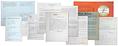 1945-1968. Bishop's first book, North & South won the Houghton Mifflin Poetry Prize Fellowship and was published in 1946. Her second volume, published nine years later and entitled Poems: North & South -- A Cold Spring (which included the first volume in its entirety), won the 1956 Pulitzer Prize. This file begins in 1945 with Bishop's 4-page, hand-written author questionnaire for Houghton Mifflin and a press release announcing the Fellowship and the coming publication of North & South. The bulk of the file is from the 1950s and contains a second author questionnaire (with responses typed by Bishop) from 1955, as well as five typed letters signed by Bishop, plus one typed note signed and a personalized list of 43 people she wished to receive gift copies of her second book. Robert Lowell and Marianne Moore contribute typed letters signed praising Bishop's work, with an additional typed postcard signed from Moore. In her letters (which are predominantly sent from Rio de Janeiro), Bishop is very engaged in the process, offering opinions on marketing, reviewers, jacket blurbs, photos and typography, and also weighs in on having been labeled a "woman" poet: "...I think it is as silly to label a woman's poetry as by a 'woman' as it would be to label a man's by a "man" -- at least in 1955. And some uninformed reviewers, or those rare purchasers, seem to feel disappointed if a 'woman' does not write about unrequited love, etc.!" She does admit to being "extremely pleased" on having learned she had won the Pulitzer Prize, adding, "I hope this will increase the sales -- enough at least to pay off my indebtedness to Houghton Mifflin." For context, there are also more than a dozen retained copies of letters from or to the publisher from various entities; several press releases; lists of potential reviewers; shipping receipts for complimentary copies; and a handful of press clippings. There is also a small stapled file of letters from 1966-68 regarding a possible reprint edition by the University of Chicago Press, when the number of paper copies of Poems in stock had fallen to less than 10. The new edition didn't happen, and this archive ends with the authorization to "melt the text plates and binder dies." (Bishop's Complete Poems was published in 1969, by Farrar, Straus and Giroux.) Apart from several instances of edge wear and some age-toning to the pages; the lot is near fine.
[#036673]
SOLD
1945-1968. Bishop's first book, North & South won the Houghton Mifflin Poetry Prize Fellowship and was published in 1946. Her second volume, published nine years later and entitled Poems: North & South -- A Cold Spring (which included the first volume in its entirety), won the 1956 Pulitzer Prize. This file begins in 1945 with Bishop's 4-page, hand-written author questionnaire for Houghton Mifflin and a press release announcing the Fellowship and the coming publication of North & South. The bulk of the file is from the 1950s and contains a second author questionnaire (with responses typed by Bishop) from 1955, as well as five typed letters signed by Bishop, plus one typed note signed and a personalized list of 43 people she wished to receive gift copies of her second book. Robert Lowell and Marianne Moore contribute typed letters signed praising Bishop's work, with an additional typed postcard signed from Moore. In her letters (which are predominantly sent from Rio de Janeiro), Bishop is very engaged in the process, offering opinions on marketing, reviewers, jacket blurbs, photos and typography, and also weighs in on having been labeled a "woman" poet: "...I think it is as silly to label a woman's poetry as by a 'woman' as it would be to label a man's by a "man" -- at least in 1955. And some uninformed reviewers, or those rare purchasers, seem to feel disappointed if a 'woman' does not write about unrequited love, etc.!" She does admit to being "extremely pleased" on having learned she had won the Pulitzer Prize, adding, "I hope this will increase the sales -- enough at least to pay off my indebtedness to Houghton Mifflin." For context, there are also more than a dozen retained copies of letters from or to the publisher from various entities; several press releases; lists of potential reviewers; shipping receipts for complimentary copies; and a handful of press clippings. There is also a small stapled file of letters from 1966-68 regarding a possible reprint edition by the University of Chicago Press, when the number of paper copies of Poems in stock had fallen to less than 10. The new edition didn't happen, and this archive ends with the authorization to "melt the text plates and binder dies." (Bishop's Complete Poems was published in 1969, by Farrar, Straus and Giroux.) Apart from several instances of edge wear and some age-toning to the pages; the lot is near fine.
[#036673]
SOLD
10.
BLOCH, Lucienne
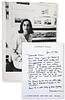 1982. An autograph note signed by Bloch, written to Nan Talese the week that Houghton Mifflin published Bloch's book Finders, Keepers. The note is a thank you, in which she says, in part: "I'm most grateful to you for the opportunity you give me to do what I can, what I must, what I will." An original 8" x 10" photo of Bloch, taken by Jerry Bauer, is included. There's also a publicity photo, and a carbon of Talese's reply. Near fine.
[#036674]
SOLD
1982. An autograph note signed by Bloch, written to Nan Talese the week that Houghton Mifflin published Bloch's book Finders, Keepers. The note is a thank you, in which she says, in part: "I'm most grateful to you for the opportunity you give me to do what I can, what I must, what I will." An original 8" x 10" photo of Bloch, taken by Jerry Bauer, is included. There's also a publicity photo, and a carbon of Talese's reply. Near fine.
[#036674]
SOLD
11.
BOYLE, Kay
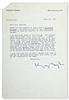 1971. A typed letter signed, written solely to praise Mary Lavin's Collected Stories, for publicity purposes. Folded for mailing, and stapled to retained copies of two notes: one a thank you to Boyle and one transcribing Boyle's comments. A nice comment, in which Boyle compares Lavin's writings to Joyce's Dubliners, but from a woman's point of view. Near fine.
[#036675]
SOLD
1971. A typed letter signed, written solely to praise Mary Lavin's Collected Stories, for publicity purposes. Folded for mailing, and stapled to retained copies of two notes: one a thank you to Boyle and one transcribing Boyle's comments. A nice comment, in which Boyle compares Lavin's writings to Joyce's Dubliners, but from a woman's point of view. Near fine.
[#036675]
SOLD
12.
BRADURY, Ray
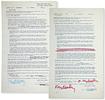 1964, 1974. Two contracts signed by Bradbury: the first agrees to publication of his story "The Other Foot" in Fifty Best American Short Stories 1915-1965; the second to publication of "February 1999: Ylla" in American Short Stories Bicentennial 1774-1975. Each is on legal-sized paper folded in fourths; near fine.
[#036676]
SOLD
1964, 1974. Two contracts signed by Bradbury: the first agrees to publication of his story "The Other Foot" in Fifty Best American Short Stories 1915-1965; the second to publication of "February 1999: Ylla" in American Short Stories Bicentennial 1774-1975. Each is on legal-sized paper folded in fourths; near fine.
[#036676]
SOLD
13.
BROWN, Rosellen
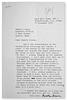 1975. Brown writes to the publisher of "the Martha Foley anthology" (The Best American Short Stories 1975) to inquire as to why reviews are appearing but she has yet to see a copy, and she also adds, "I found it disconcerting at the time you sent out word of the anthology's choices never to be informed directly myself....There are surely enough such distances in the world already without alienating writers from the fate of their writing on those few fine occasions when it's a good one." Signed by Brown. Stapled to a note indicating a copy of the book has been sent. Near fine. A small glimpse at the isolation a writer could feel (in the last quarter of the last century) in pursuing her solitary literary journey. Brown's novel The Autobiography of My Mother would come out the following year.
[#036677]
SOLD
1975. Brown writes to the publisher of "the Martha Foley anthology" (The Best American Short Stories 1975) to inquire as to why reviews are appearing but she has yet to see a copy, and she also adds, "I found it disconcerting at the time you sent out word of the anthology's choices never to be informed directly myself....There are surely enough such distances in the world already without alienating writers from the fate of their writing on those few fine occasions when it's a good one." Signed by Brown. Stapled to a note indicating a copy of the book has been sent. Near fine. A small glimpse at the isolation a writer could feel (in the last quarter of the last century) in pursuing her solitary literary journey. Brown's novel The Autobiography of My Mother would come out the following year.
[#036677]
SOLD
14.
BURNS, Olive Ann
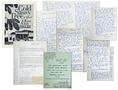 1984-1985. A file of correspondence pertaining to Burns's only novel completed in her lifetime. Burns began writing Cold Sassy Tree after she was diagnosed with lymphoma; it was published in 1984, when Burns was 60 years old. She died at 65, and the unfinished sequel, Leaving Cold Sassy, was published posthumously. Burns's letters (four autograph letters signed, one of which is five pages long; and one typed letter signed) all date from 1985, after the book's publication: they address sales, best seller lists, travel for readings and speaking engagements, tax questions, the paperback release, the airing of the entire book on Wisconsin Public Radio, and Jimmy Carter's endorsement of her book (relayed to her third-hand). Burns also writes of working on the sequel, here titled Time, Dirt, and Money. Also included: approximately ten very detailed expense account reports that Burns submitted for travel reimbursement, one of which has an additional autograph note signed attached. There are also two announcements of author readings; a press clipping; and an unused invitation to the publication party. Cold Sassy Tree was a highly praised coming-of-age novel depicting small town Georgia life at the turn of the 20th century. It was derived from family stories that had been passed down to Burns. The lot is fine.
[#036678]
SOLD
1984-1985. A file of correspondence pertaining to Burns's only novel completed in her lifetime. Burns began writing Cold Sassy Tree after she was diagnosed with lymphoma; it was published in 1984, when Burns was 60 years old. She died at 65, and the unfinished sequel, Leaving Cold Sassy, was published posthumously. Burns's letters (four autograph letters signed, one of which is five pages long; and one typed letter signed) all date from 1985, after the book's publication: they address sales, best seller lists, travel for readings and speaking engagements, tax questions, the paperback release, the airing of the entire book on Wisconsin Public Radio, and Jimmy Carter's endorsement of her book (relayed to her third-hand). Burns also writes of working on the sequel, here titled Time, Dirt, and Money. Also included: approximately ten very detailed expense account reports that Burns submitted for travel reimbursement, one of which has an additional autograph note signed attached. There are also two announcements of author readings; a press clipping; and an unused invitation to the publication party. Cold Sassy Tree was a highly praised coming-of-age novel depicting small town Georgia life at the turn of the 20th century. It was derived from family stories that had been passed down to Burns. The lot is fine.
[#036678]
SOLD
15.
BURROUGHS, Franklin
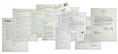 1991-1992. Six pieces of correspondence (4 autograph letters signed and 2 typed letters signed) from Burroughs to his publisher; along with a file of signed letters of praise for Burroughs from Jim Harrison, Tom McGuane, Rick Bass, Edward Hoagland, Geoffrey Wolff, and Scott Russell Sanders (plus a postcard from Donald Hall, declining to comment). Franklin Burroughs won the John Burroughs Medal for his book Confluence. These letters pertain to the Houghton Mifflin paperback release of his earlier book, the collection of essays Billy Watson's Croker Sack. Burroughs' letters are much involved with corrections for the re-issue (including forwarding a list that was handed to him by a stranger), as well as responding (not always positively) to the "praise" the book received -- although he also thanks his publisher for sending him Robert Pyle's Wintergreen, another John Burroughs Medal winner. Both Bass's and Wolff's glowing words were too long to use in full (and, in Bass's case, includes a swipe at chain book stores). Harrison, after the submitted "blurb," adds "Bet he could write a fine novel as he appears to understand everything." Hoagland, off the record, finds the book too short, "just as a book is now accepted at being 150 pages, a wilderness is accepted at being two miles across, instead of twenty." More from Bass: "This book will move from heart to heart, throughout the country, for a hundred years, or longer: for as long as there are books and readers." The lot is fine.
[#036679]
SOLD
1991-1992. Six pieces of correspondence (4 autograph letters signed and 2 typed letters signed) from Burroughs to his publisher; along with a file of signed letters of praise for Burroughs from Jim Harrison, Tom McGuane, Rick Bass, Edward Hoagland, Geoffrey Wolff, and Scott Russell Sanders (plus a postcard from Donald Hall, declining to comment). Franklin Burroughs won the John Burroughs Medal for his book Confluence. These letters pertain to the Houghton Mifflin paperback release of his earlier book, the collection of essays Billy Watson's Croker Sack. Burroughs' letters are much involved with corrections for the re-issue (including forwarding a list that was handed to him by a stranger), as well as responding (not always positively) to the "praise" the book received -- although he also thanks his publisher for sending him Robert Pyle's Wintergreen, another John Burroughs Medal winner. Both Bass's and Wolff's glowing words were too long to use in full (and, in Bass's case, includes a swipe at chain book stores). Harrison, after the submitted "blurb," adds "Bet he could write a fine novel as he appears to understand everything." Hoagland, off the record, finds the book too short, "just as a book is now accepted at being 150 pages, a wilderness is accepted at being two miles across, instead of twenty." More from Bass: "This book will move from heart to heart, throughout the country, for a hundred years, or longer: for as long as there are books and readers." The lot is fine.
[#036679]
SOLD
16.
(CARSON, Rachel). TEALE, Edwin Way and BORLAND, Hal
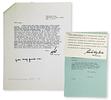 1969-1970. Teale and Borland provide comments for Frank Graham's 1970 book Since Silent Spring, which told the story of Carson's writing Silent Spring, the controversy it engendered, and the continuation of her cause in the intervening years (as, despite Carson's success, DDT was not fully banned until 1972). Borland, in a typed letter signed, both praises Graham's book and recounts his own battle against DDT that he was waging as Carson wrote. Teale (who had also written about DDT prior to Silent Spring) in a typed postcard signed praises Graham's book and also Carson, whom he calls "a remarkable woman." Both items are stapled to retained copies of thanks from the publisher; the Borland is folded for mailing; else the lot is fine. Borland and Teale were both recipients of the John Burroughs Medal for a distinguished book of nature writing, as was Rachel Carson.
[#036681]
SOLD
1969-1970. Teale and Borland provide comments for Frank Graham's 1970 book Since Silent Spring, which told the story of Carson's writing Silent Spring, the controversy it engendered, and the continuation of her cause in the intervening years (as, despite Carson's success, DDT was not fully banned until 1972). Borland, in a typed letter signed, both praises Graham's book and recounts his own battle against DDT that he was waging as Carson wrote. Teale (who had also written about DDT prior to Silent Spring) in a typed postcard signed praises Graham's book and also Carson, whom he calls "a remarkable woman." Both items are stapled to retained copies of thanks from the publisher; the Borland is folded for mailing; else the lot is fine. Borland and Teale were both recipients of the John Burroughs Medal for a distinguished book of nature writing, as was Rachel Carson.
[#036681]
SOLD
17.
CHANDLER, Raymond
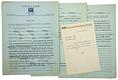 ca. 1939. A 3-page author questionnaire, given to new authors by Alfred Knopf, and here filled out (via typewriter) by Chandler, likely at the time Knopf was publishing his first book, The Big Sleep (1939). Includes information such as name, birthplace and date, address, education, occupations, spouse, countries traveled, honors, hobbies and interests, and "Boswelliana." Here's Chandler on his hobbies: "Travel, reading, music. No organized games. Loathe bridge and golf and can't play tennis or squash anymore. Like tea drinking, pipe smoking, loathe drunks and don't drink at all. My secretary is an 18 lb. black Persian cat. Like to walk, but not hike, study wildlife, etc. Hell, I don't know what I like." Note: not signed. Chandler would have been about 50 at this time. A note is enclosed, initialed by Alfred A. Knopf, dated in 1945: "Raymond Chandler continues to request us -- and that is putting it mildly -- not to publish ever the date of his birth." This has been noted on the questionnaire as well. To the publisher's query about the background of his latest book, Chandler writes that "it's a great spot for a few bum wisecracks, but I'm leaving them out." Edge-sunned, with mild edge wear; previously folded in thirds; very good.
[#036682]
SOLD
ca. 1939. A 3-page author questionnaire, given to new authors by Alfred Knopf, and here filled out (via typewriter) by Chandler, likely at the time Knopf was publishing his first book, The Big Sleep (1939). Includes information such as name, birthplace and date, address, education, occupations, spouse, countries traveled, honors, hobbies and interests, and "Boswelliana." Here's Chandler on his hobbies: "Travel, reading, music. No organized games. Loathe bridge and golf and can't play tennis or squash anymore. Like tea drinking, pipe smoking, loathe drunks and don't drink at all. My secretary is an 18 lb. black Persian cat. Like to walk, but not hike, study wildlife, etc. Hell, I don't know what I like." Note: not signed. Chandler would have been about 50 at this time. A note is enclosed, initialed by Alfred A. Knopf, dated in 1945: "Raymond Chandler continues to request us -- and that is putting it mildly -- not to publish ever the date of his birth." This has been noted on the questionnaire as well. To the publisher's query about the background of his latest book, Chandler writes that "it's a great spot for a few bum wisecracks, but I'm leaving them out." Edge-sunned, with mild edge wear; previously folded in thirds; very good.
[#036682]
SOLD
18.
CHEEVER, John
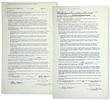 1964, 1974. Two contracts signed by Cheever: the first agrees to publication of his story "The Enormous Radio" in Fifty Best American Short Stories 1915-1965; the second to publication of "The Country Husband" in American Short Stories Bicentennial 1774-1975. Each is on legal-sized paper folded in fourths; near fine. "The Enormous Radio" was the title story in Cheever's second collection, published in 1953.
[#036683]
SOLD
1964, 1974. Two contracts signed by Cheever: the first agrees to publication of his story "The Enormous Radio" in Fifty Best American Short Stories 1915-1965; the second to publication of "The Country Husband" in American Short Stories Bicentennial 1774-1975. Each is on legal-sized paper folded in fourths; near fine. "The Enormous Radio" was the title story in Cheever's second collection, published in 1953.
[#036683]
SOLD
19.
CHUTE, Carolyn
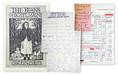 1985. Two autograph letters signed written to her editor the year that her first book, The Beans of Egypt, Maine was published. The first, 4 pages (two sides of two pages) mostly discusses readings and plans for readings (and meeting Joan Chase and missing meeting Tillie Olsen) and her acceptance into MacDowell (writers' residency program). The second letter runs seven sides of small note paper and explains that her husband Michael has a receipt somewhere for "about $8 for the gas we bought in Houlton"; that she forgot to get a receipt for the gas she bought when they got home; and she wonders if Michael will still get paid for driving now that they have royalty money. On the bottom of the 7th page, she notes that the blank 8th page can be used "for scrap." Receipts for the rental car and for phone calls made for publicity purposes are included, as is an unused invitation to the book launch. A telling, even exemplary, pair of letters: Chute's novel was praised for its authenticity in depicting the hardscrabble lives of her Maine characters, including their economic insecurity, and these letters reflect her not taking these kinds of expenses, or their reimbursement, for granted. The lot is near fine.
[#036684]
SOLD
1985. Two autograph letters signed written to her editor the year that her first book, The Beans of Egypt, Maine was published. The first, 4 pages (two sides of two pages) mostly discusses readings and plans for readings (and meeting Joan Chase and missing meeting Tillie Olsen) and her acceptance into MacDowell (writers' residency program). The second letter runs seven sides of small note paper and explains that her husband Michael has a receipt somewhere for "about $8 for the gas we bought in Houlton"; that she forgot to get a receipt for the gas she bought when they got home; and she wonders if Michael will still get paid for driving now that they have royalty money. On the bottom of the 7th page, she notes that the blank 8th page can be used "for scrap." Receipts for the rental car and for phone calls made for publicity purposes are included, as is an unused invitation to the book launch. A telling, even exemplary, pair of letters: Chute's novel was praised for its authenticity in depicting the hardscrabble lives of her Maine characters, including their economic insecurity, and these letters reflect her not taking these kinds of expenses, or their reimbursement, for granted. The lot is near fine.
[#036684]
SOLD
20.
CONROY, Pat
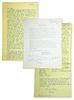 1971-1976. In 1976, just prior to the publication of The Great Santini, Conroy submits an autobiography to his publisher in the form of an autograph letter signed, for use in promoting the book. Over the course of four densely written legal-sized pages, Conroy blends fiction (“Men with camels and shepherds with their flocks wended their way toward the Naval Air Station”) with fact (such as listing the many places he grew up) and reflection (“I am sentimental about roots because I never had any”). He talks of taking a playwriting class in San Francisco where he wrote the play that became the basis for The Great Santini, as well as taking a class from James Dickey after he wrote The Water is Wide “because of a growing awareness that I did not know how to write.” He notes that at the Citadel he is remembered as a “good athlete, a fair student, and a lousy cadet.” He relays some of his basketball statistics and adds that he later became “one of the worst coaches in the history of organized athletics.” He discloses having had his first book, The Boo, published by a vanity press (“I thought all authors had to pay to have their books printed”) and confesses an early embarrassment about the book that has since turned into pride “not because of its content or style but because of its spirit.” He mentions that The Water is Wide won the Anisfield-Wolf Award (for contributions to the understanding of racism), and he offers a long paragraph on his sister, Carol, the better writer in the family. Conroy ends with a list of fictitious hobbies, and he signs off “Yours in service to the language, Pat Conroy.” Five years earlier, prior to the publication of The Water is Wide, Conroy submitted an author questionnaire in which he covered much of this same ground, but in it he also explains when and how he became a writer and his writing habits (“Completely erratic. I enjoy blaming my wife, family, and friends for my inability to write on certain days...”), as well as listing his writing influences. He lists his hobbies and names the difficulties (“depression, ennui, laziness”) that made the writing difficult. This questionnaire is present in photocopy form, including a signed note on the cover page apologizing for its late submission. Included with Conroy's autobiographical letter and questionnaire are an autograph postcard signed from MacKinley Kantor and a typed note signed from Ernest K. Gann, each explaining they don't at the moment have the time to read the book (The Great Santini), as well as a 1980 publicity photo of Conroy. Several instances of publisher's markings to the documents; the letter is folded in uneven fourths. The lot is near fine. A humorous, self-deprecating mini-autobiography, as might be expected from the author of The Boo and The Great Santini.
[#036685]
SOLD
1971-1976. In 1976, just prior to the publication of The Great Santini, Conroy submits an autobiography to his publisher in the form of an autograph letter signed, for use in promoting the book. Over the course of four densely written legal-sized pages, Conroy blends fiction (“Men with camels and shepherds with their flocks wended their way toward the Naval Air Station”) with fact (such as listing the many places he grew up) and reflection (“I am sentimental about roots because I never had any”). He talks of taking a playwriting class in San Francisco where he wrote the play that became the basis for The Great Santini, as well as taking a class from James Dickey after he wrote The Water is Wide “because of a growing awareness that I did not know how to write.” He notes that at the Citadel he is remembered as a “good athlete, a fair student, and a lousy cadet.” He relays some of his basketball statistics and adds that he later became “one of the worst coaches in the history of organized athletics.” He discloses having had his first book, The Boo, published by a vanity press (“I thought all authors had to pay to have their books printed”) and confesses an early embarrassment about the book that has since turned into pride “not because of its content or style but because of its spirit.” He mentions that The Water is Wide won the Anisfield-Wolf Award (for contributions to the understanding of racism), and he offers a long paragraph on his sister, Carol, the better writer in the family. Conroy ends with a list of fictitious hobbies, and he signs off “Yours in service to the language, Pat Conroy.” Five years earlier, prior to the publication of The Water is Wide, Conroy submitted an author questionnaire in which he covered much of this same ground, but in it he also explains when and how he became a writer and his writing habits (“Completely erratic. I enjoy blaming my wife, family, and friends for my inability to write on certain days...”), as well as listing his writing influences. He lists his hobbies and names the difficulties (“depression, ennui, laziness”) that made the writing difficult. This questionnaire is present in photocopy form, including a signed note on the cover page apologizing for its late submission. Included with Conroy's autobiographical letter and questionnaire are an autograph postcard signed from MacKinley Kantor and a typed note signed from Ernest K. Gann, each explaining they don't at the moment have the time to read the book (The Great Santini), as well as a 1980 publicity photo of Conroy. Several instances of publisher's markings to the documents; the letter is folded in uneven fourths. The lot is near fine. A humorous, self-deprecating mini-autobiography, as might be expected from the author of The Boo and The Great Santini.
[#036685]
SOLD
21.
DELATTRE, Pierre & FERLINGHETTI, Lawrence
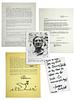 1971. Four typed letters signed from Delattre and two autograph postcards signed from Lawrence Ferlinghetti, written to two women from the publisher of Delattre's 1971 novel Tales of a Dalai Lama. Delattre's first letter is highly descriptive of his move from Mexico to California. He also asks for the name of the first girl to have read his manuscript, as he wants to write to her. A postcard from Ferlinghetti here says to ask Delattre for the blurb that he gave him to be used for publication. Apparently Ferlinghetti had told Delattre that if Houghton Mifflin wouldn't publish Tales of a Dalai Lama, he (City Lights Books) would. The next Delattre letter discusses ways to get Ferlinghetti to elaborate on his comment, but then candidly also lists the reasons he hadn't wanted to be published by City Lights. Ferlinghetti does send another postcard, editing his blurb to seven words. The final two letters from Delattre mention how thrilled he is with the final book and discuss promotional strategies. There is also a very long typed letter signed from writer Alan Marcus, itemizing in detail the publicity that Houghton Mifflin should undertake on behalf of Delattre. Included are a press release and author photo for Dalai Lama (as well as a photo and press release for Delattre's later book, Walking on Air); Delattre's handwritten return address in Mexico, torn from an envelope; and a half dozen retained copies of letters from the publisher, providing context. The lot is near fine.
[#036686]
SOLD
1971. Four typed letters signed from Delattre and two autograph postcards signed from Lawrence Ferlinghetti, written to two women from the publisher of Delattre's 1971 novel Tales of a Dalai Lama. Delattre's first letter is highly descriptive of his move from Mexico to California. He also asks for the name of the first girl to have read his manuscript, as he wants to write to her. A postcard from Ferlinghetti here says to ask Delattre for the blurb that he gave him to be used for publication. Apparently Ferlinghetti had told Delattre that if Houghton Mifflin wouldn't publish Tales of a Dalai Lama, he (City Lights Books) would. The next Delattre letter discusses ways to get Ferlinghetti to elaborate on his comment, but then candidly also lists the reasons he hadn't wanted to be published by City Lights. Ferlinghetti does send another postcard, editing his blurb to seven words. The final two letters from Delattre mention how thrilled he is with the final book and discuss promotional strategies. There is also a very long typed letter signed from writer Alan Marcus, itemizing in detail the publicity that Houghton Mifflin should undertake on behalf of Delattre. Included are a press release and author photo for Dalai Lama (as well as a photo and press release for Delattre's later book, Walking on Air); Delattre's handwritten return address in Mexico, torn from an envelope; and a half dozen retained copies of letters from the publisher, providing context. The lot is near fine.
[#036686]
SOLD
22.
DELILLO, Don
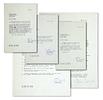 1971-1972. Three typed letters signed and two typed notes signed by DeLillo, all written to his publisher and regarding his second and third books, End Zone and Great Jones Street. The first two letters clarify a dozen or so changes to End Zone, with the second containing a brief discussion of the Vienna Circle of philosophers. A third note corrects a typo ("cases" for "oases"). In the fourth letter, DeLillo defends his abbreviation of "Dr." for the character of Dr. Pepper [in Great Jones Street], in part, "I'd like the character's name to echo the brand name as closely as possible." He also agrees that they are "well on our way to setting some sort of book-a-year record." The fifth note alludes to a missing manuscript, about which he is not "unduly bereaved." Also included is one photocopied internal memo from 1971 saying that DeLillo has agreed to the title change, from The Self-Erasing Word to End Zone, provided that it be spelled as two words. The lot is fine. An early look at DeLillo's writing: his winning the National Book Award in 1985 for White Noise elevated him to the top tier of American literature, and each of his books after that point was viewed as a major literary event.
[#036687]
SOLD
1971-1972. Three typed letters signed and two typed notes signed by DeLillo, all written to his publisher and regarding his second and third books, End Zone and Great Jones Street. The first two letters clarify a dozen or so changes to End Zone, with the second containing a brief discussion of the Vienna Circle of philosophers. A third note corrects a typo ("cases" for "oases"). In the fourth letter, DeLillo defends his abbreviation of "Dr." for the character of Dr. Pepper [in Great Jones Street], in part, "I'd like the character's name to echo the brand name as closely as possible." He also agrees that they are "well on our way to setting some sort of book-a-year record." The fifth note alludes to a missing manuscript, about which he is not "unduly bereaved." Also included is one photocopied internal memo from 1971 saying that DeLillo has agreed to the title change, from The Self-Erasing Word to End Zone, provided that it be spelled as two words. The lot is fine. An early look at DeLillo's writing: his winning the National Book Award in 1985 for White Noise elevated him to the top tier of American literature, and each of his books after that point was viewed as a major literary event.
[#036687]
SOLD
23.
DICKEY, James
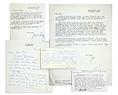 1963-1976. A typed note signed and a typed letter signed by Dickey; an autograph letter signed by Walker Percy and an autograph postcard signed by William Goyen; plus nearly a dozen retained copies of letters, memos, and telegrams from the publisher regarding Dickey's 1970 novel Deliverance, which made the Modern Library's list of top 100 novels of the 20th century and was made into a film in 1972, with a screenplay by Dickey, which was nominated for an Academy Award for Best Picture. In the 1960s, in the midst of his success as a poet, Dickey began working on Deliverance, his first novel. (The first item here is a Contributors page torn from Poetry magazine, in which he is said to be working on his novel, The Deliverer.) By late 1963, he was in talks with Random House about publication. The two letters from Dickey at this time (1963 and 1964) both have to do with arrangements for meeting. Shortly after, Dickey is given $250 for the option on the novel, and retained letters from the publisher indicate revisions are in process. The paper trail disappears from 1965 until 1969, when Walker Percy pens a letter with advance comments (some good: "a very good adventure story"; some less so: "...unavailing, not foreshadowing what is to come"; and concluding: "It looks like Dickey, a good poet wanted to take off and have a good time with an adventure yarn and maybe make a lot of money on a movie. It probably will." William Goyen's praises were higher (in part): "It has that mysterious inner driving force that true poetry has..." Lastly here, there is a much later (1976) typed postcard signed by Dickey in which he comments on an Al Poulin translation of Rilke, saying that no previous Rilke translator "has been anywhere near the essential Rilke that Poulin has been able to reach." Publisher's notations on some pages; the lot is near fine. Percy's comment was remarkably prescient; and it is interesting to see the novel as a work-in-progress for more than 7 years prior to publication.
[#036688]
SOLD
1963-1976. A typed note signed and a typed letter signed by Dickey; an autograph letter signed by Walker Percy and an autograph postcard signed by William Goyen; plus nearly a dozen retained copies of letters, memos, and telegrams from the publisher regarding Dickey's 1970 novel Deliverance, which made the Modern Library's list of top 100 novels of the 20th century and was made into a film in 1972, with a screenplay by Dickey, which was nominated for an Academy Award for Best Picture. In the 1960s, in the midst of his success as a poet, Dickey began working on Deliverance, his first novel. (The first item here is a Contributors page torn from Poetry magazine, in which he is said to be working on his novel, The Deliverer.) By late 1963, he was in talks with Random House about publication. The two letters from Dickey at this time (1963 and 1964) both have to do with arrangements for meeting. Shortly after, Dickey is given $250 for the option on the novel, and retained letters from the publisher indicate revisions are in process. The paper trail disappears from 1965 until 1969, when Walker Percy pens a letter with advance comments (some good: "a very good adventure story"; some less so: "...unavailing, not foreshadowing what is to come"; and concluding: "It looks like Dickey, a good poet wanted to take off and have a good time with an adventure yarn and maybe make a lot of money on a movie. It probably will." William Goyen's praises were higher (in part): "It has that mysterious inner driving force that true poetry has..." Lastly here, there is a much later (1976) typed postcard signed by Dickey in which he comments on an Al Poulin translation of Rilke, saying that no previous Rilke translator "has been anywhere near the essential Rilke that Poulin has been able to reach." Publisher's notations on some pages; the lot is near fine. Percy's comment was remarkably prescient; and it is interesting to see the novel as a work-in-progress for more than 7 years prior to publication.
[#036688]
SOLD
24.
DOS PASSOS, John
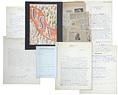 1942-1971. An archive spanning nearly the entirety of Dos Passos' decades as a Houghton Mifflin author, and including three typed letters signed; one autograph letter signed; and two author questionnaires filled out by Dos Passos by hand: the first quite sparsely (and likely very early in his career); the second running 7 pages, and also incompletely filled out, but Dos Passos has answered questions concerning his birthplace; cumulative residences; education; occupations; hobbies (sailing, gardening, walking); thoughts on promoting his work (to the "readers, maybe, of [Drury's] Advise and Consent"); etc. He references Melvin Landsberg's doctoral thesis as a place to get the answers he himself has not supplied. The first typed letter signed included here (December, 1942) is a 3-page autobiography. The remaining three letters address issues of his advance; his place of residence; potential meetings; author photos; etc. Four biographical summaries of Dos Passos issued by the publisher (1951, 1961, 1966, and 1967) are included, along with approximately 20 press releases and/or copies of text for press releases for Dos Passos publications. Additionally, there are more than three dozen retained copies of letters and internal memos (regarding readings, publicity, blurbs, interviews, etc.) and more than a dozen clippings of book reviews and the author's obituaries. Lastly, there are proof dust jackets for three Dos Passos titles, the typed jacket copy of a fourth, and a 36-page promotional brochure for the 1946 release of the illustrated, three-volume edition of U.S.A., which includes a biography, a bibliography, critiques of the author's works, a discussion of his technique, etc. Dos Passos was a contemporary of Hemingway, Gertrude Stein and E.E. Cummings, and his "U.S.A. Trilogy" is one of the high spots of 20th century American literature. Autograph material by Dos Passos -- or any of that generation of American writers -- is increasingly uncommon. His long career with Houghton Mifflin is visible in virtually every aspect in this archive. One of Dos Passos' letters has publisher's markings across the text; the brochure has internal notations; the lot is near fine.
[#036689]
SOLD
1942-1971. An archive spanning nearly the entirety of Dos Passos' decades as a Houghton Mifflin author, and including three typed letters signed; one autograph letter signed; and two author questionnaires filled out by Dos Passos by hand: the first quite sparsely (and likely very early in his career); the second running 7 pages, and also incompletely filled out, but Dos Passos has answered questions concerning his birthplace; cumulative residences; education; occupations; hobbies (sailing, gardening, walking); thoughts on promoting his work (to the "readers, maybe, of [Drury's] Advise and Consent"); etc. He references Melvin Landsberg's doctoral thesis as a place to get the answers he himself has not supplied. The first typed letter signed included here (December, 1942) is a 3-page autobiography. The remaining three letters address issues of his advance; his place of residence; potential meetings; author photos; etc. Four biographical summaries of Dos Passos issued by the publisher (1951, 1961, 1966, and 1967) are included, along with approximately 20 press releases and/or copies of text for press releases for Dos Passos publications. Additionally, there are more than three dozen retained copies of letters and internal memos (regarding readings, publicity, blurbs, interviews, etc.) and more than a dozen clippings of book reviews and the author's obituaries. Lastly, there are proof dust jackets for three Dos Passos titles, the typed jacket copy of a fourth, and a 36-page promotional brochure for the 1946 release of the illustrated, three-volume edition of U.S.A., which includes a biography, a bibliography, critiques of the author's works, a discussion of his technique, etc. Dos Passos was a contemporary of Hemingway, Gertrude Stein and E.E. Cummings, and his "U.S.A. Trilogy" is one of the high spots of 20th century American literature. Autograph material by Dos Passos -- or any of that generation of American writers -- is increasingly uncommon. His long career with Houghton Mifflin is visible in virtually every aspect in this archive. One of Dos Passos' letters has publisher's markings across the text; the brochure has internal notations; the lot is near fine.
[#036689]
SOLD
25.
DUNCAN, David Douglas
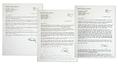 1982-1983. Three typed letters signed from Duncan to his publisher, each with detailed disappointments with the publisher's handling of the promotion of his book The World of Allah, a collection of photos taken between the 1940s and 1970s depicting people's lives across the Muslim world. Duncan specifically references the failure to tie the book "to the constant newsbreaks out of the Middle East." Near fine. Duncan was one of the preeminent photojournalists of the 20th century; his Vietnam book, War Without Heroes stands as one of the definitive books on that war.
[#036690]
SOLD
1982-1983. Three typed letters signed from Duncan to his publisher, each with detailed disappointments with the publisher's handling of the promotion of his book The World of Allah, a collection of photos taken between the 1940s and 1970s depicting people's lives across the Muslim world. Duncan specifically references the failure to tie the book "to the constant newsbreaks out of the Middle East." Near fine. Duncan was one of the preeminent photojournalists of the 20th century; his Vietnam book, War Without Heroes stands as one of the definitive books on that war.
[#036690]
SOLD
26.
ESTLEMAN, Loren D.
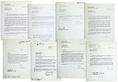 1980-1983. More than 30 pieces of correspondence (22 typed letters signed and 10 typed notes signed) from Estleman, written to his publisher during the time frame of his second, third, and fourth Amos Walker detective novels (Angel Eyes, The Midnight Man, and The Glass Highway). In the very first letter, Estleman delves into multiple facets of his protagonist's (Amos Walker's) character: "I hadn't realized that his lifestyle was so repugnant, perhaps because in some particulars it echo es my own..." He then spends paragraphs on his character's diet, decor, distrusts, hobbies, fitness habits, choice of car, mental health, physical health, (lack of) personal opinions, and his saving wit. In another letter, Estleman hashes out a response to a review of his first Amos Walker book, Motor City Blues, in part by contrasting himself with the traditions of Hammett, Chandler, Spillane, Ross Macdonald, John D. MacDonald, and Robert Parker. The first letter mentioning The Midnight Man exposes the struggles he had writing it. Some of the letters in this collection submit the author's revisions (generally not included save for one batch of 7 changes), accompanied by satisfying, detailed explanations for the changes. Some of his letters offer his well thought-out opinions of his critics; some offer marketing input. A long letter addressing The Glass Highway echoes the first letter here, which addressed Angel Eyes, and delves into Walker's character, providing behind-the-scenes insights "to lift some of the ambiguities from Walker's actions." In addition to the author's correspondence, there is a typed letter signed from Robert Parker declining to offer words of praise for publicity, as "I have to reserve them for friends (I'm infinitely corruptible) or books for which I have an uncontrollable enthusiasm." Jon Winters (pseudonym of Gilbert Cross) submits praise in a typed letter signed, and is apparently so uncomfortable with his pseudonym he mistypes his name; and there are two typed notes signed by Donald Hamilton. A dozen retained copies of letters provide context. Occasional publisher's markings on the letters; otherwise the lot is fine.
[#036691]
SOLD
1980-1983. More than 30 pieces of correspondence (22 typed letters signed and 10 typed notes signed) from Estleman, written to his publisher during the time frame of his second, third, and fourth Amos Walker detective novels (Angel Eyes, The Midnight Man, and The Glass Highway). In the very first letter, Estleman delves into multiple facets of his protagonist's (Amos Walker's) character: "I hadn't realized that his lifestyle was so repugnant, perhaps because in some particulars it echo es my own..." He then spends paragraphs on his character's diet, decor, distrusts, hobbies, fitness habits, choice of car, mental health, physical health, (lack of) personal opinions, and his saving wit. In another letter, Estleman hashes out a response to a review of his first Amos Walker book, Motor City Blues, in part by contrasting himself with the traditions of Hammett, Chandler, Spillane, Ross Macdonald, John D. MacDonald, and Robert Parker. The first letter mentioning The Midnight Man exposes the struggles he had writing it. Some of the letters in this collection submit the author's revisions (generally not included save for one batch of 7 changes), accompanied by satisfying, detailed explanations for the changes. Some of his letters offer his well thought-out opinions of his critics; some offer marketing input. A long letter addressing The Glass Highway echoes the first letter here, which addressed Angel Eyes, and delves into Walker's character, providing behind-the-scenes insights "to lift some of the ambiguities from Walker's actions." In addition to the author's correspondence, there is a typed letter signed from Robert Parker declining to offer words of praise for publicity, as "I have to reserve them for friends (I'm infinitely corruptible) or books for which I have an uncontrollable enthusiasm." Jon Winters (pseudonym of Gilbert Cross) submits praise in a typed letter signed, and is apparently so uncomfortable with his pseudonym he mistypes his name; and there are two typed notes signed by Donald Hamilton. A dozen retained copies of letters provide context. Occasional publisher's markings on the letters; otherwise the lot is fine.
[#036691]
SOLD
27.
EVANS, Walker
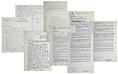 1961-1972. A small archive of correspondence, internal memos, and contracts from the period (mostly following the 1966 publication of Many Are Called) when Evans was under contract for two additional books for Houghton Mifflin, neither of which was ever published. The archive begins with an internal document from 1961 discussing the possibility of Houghton Mifflin buying out Evans' contract with Doubleday and outlining the three projects Evans is working on. The backstory to this archive is that Houghton Mifflin published Evans' collaboration with James Agee, Let Us Now Praise Famous Men, in 1941 and immediately made Evans a superstar in the world of photography, melding photojournalism with photography as art in an unprecedented manner. When they reissued the book in 1960, with 31 additional photographs by Evans, that reputation was enhanced even more. So this archive shows the publisher trying to capitalize on Evans' reputation and fame, and Evans trying to give them something to work with. By inference, it points up what a fortuitous series of events were involved in the success of the first book, appearing as it did just after the Depression and right before the Second World War. In an undated (ca. January 1961) autograph letter signed, Evans writes about visiting Kentucky, Tennessee, and Pennsylvania, and continuing his work on "poverty and distression." (His piece "People and Places in Trouble" appeared in the March 1961 issue of Fortune.) Later in 1961, editor Lovell Thompson writes to Evans proposing two books that HM would like to see from him. Six years later, in 1967, Evans responds with an autograph letter signed suggesting two different books, and he encloses a two-page, typed, formal book proposal for the titles "Types of the Time: an Illustrated Social Register" and "American Photographs: Second Series," suggesting that the former could "be ready for book manufacture by year's end, though I should prefer not to set a final date at this writing." Herein follows a signed contract, albeit with revisions: apparently a finalized contract was then drafted and sent out. Internal correspondence in the following years shows the staff concerned with protecting/returning the Evans photographs that they have on hand; having the proper permissions from Evans' photographic subjects; and the progress, or lack thereof, of the titles under contract. Three years later, with no projects in hand, Thompson retired, the contracts missing (and the advance long gone), a new contract is issued and signed by Evans, in 1970. Several months later, attempts are made by Houghton Mifflin to cancel the contract and to request the return of a least a part of the advance, which was paid in 1967. Three letters to Evans in 1970, then one in 1971, and one in 1972, all apparently go unanswered. Evans died in 1975 (despite there being a file folder here with his name dated 1976); and these final two projects went unpublished. In all two autograph letters signed by Evans, two book proposals typed by him, and two signed contracts, as well as more than two dozen retained copies of memos and correspondence providing context during these times. The very first memo, from 1961, is split in half; the remainder of the lot is near fine.
[#036692]
SOLD
1961-1972. A small archive of correspondence, internal memos, and contracts from the period (mostly following the 1966 publication of Many Are Called) when Evans was under contract for two additional books for Houghton Mifflin, neither of which was ever published. The archive begins with an internal document from 1961 discussing the possibility of Houghton Mifflin buying out Evans' contract with Doubleday and outlining the three projects Evans is working on. The backstory to this archive is that Houghton Mifflin published Evans' collaboration with James Agee, Let Us Now Praise Famous Men, in 1941 and immediately made Evans a superstar in the world of photography, melding photojournalism with photography as art in an unprecedented manner. When they reissued the book in 1960, with 31 additional photographs by Evans, that reputation was enhanced even more. So this archive shows the publisher trying to capitalize on Evans' reputation and fame, and Evans trying to give them something to work with. By inference, it points up what a fortuitous series of events were involved in the success of the first book, appearing as it did just after the Depression and right before the Second World War. In an undated (ca. January 1961) autograph letter signed, Evans writes about visiting Kentucky, Tennessee, and Pennsylvania, and continuing his work on "poverty and distression." (His piece "People and Places in Trouble" appeared in the March 1961 issue of Fortune.) Later in 1961, editor Lovell Thompson writes to Evans proposing two books that HM would like to see from him. Six years later, in 1967, Evans responds with an autograph letter signed suggesting two different books, and he encloses a two-page, typed, formal book proposal for the titles "Types of the Time: an Illustrated Social Register" and "American Photographs: Second Series," suggesting that the former could "be ready for book manufacture by year's end, though I should prefer not to set a final date at this writing." Herein follows a signed contract, albeit with revisions: apparently a finalized contract was then drafted and sent out. Internal correspondence in the following years shows the staff concerned with protecting/returning the Evans photographs that they have on hand; having the proper permissions from Evans' photographic subjects; and the progress, or lack thereof, of the titles under contract. Three years later, with no projects in hand, Thompson retired, the contracts missing (and the advance long gone), a new contract is issued and signed by Evans, in 1970. Several months later, attempts are made by Houghton Mifflin to cancel the contract and to request the return of a least a part of the advance, which was paid in 1967. Three letters to Evans in 1970, then one in 1971, and one in 1972, all apparently go unanswered. Evans died in 1975 (despite there being a file folder here with his name dated 1976); and these final two projects went unpublished. In all two autograph letters signed by Evans, two book proposals typed by him, and two signed contracts, as well as more than two dozen retained copies of memos and correspondence providing context during these times. The very first memo, from 1961, is split in half; the remainder of the lot is near fine.
[#036692]
SOLD
28.
FANTE, John
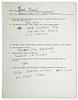 [1976]. An 8-page author questionnaire filled out by Fante prior to the publication of his 1977 novel The Brotherhood of the Grape. Fante gives basic information such as address, place and date of birth, marital status, education, previous employment ("screenwriter off and on since 1940"), and previous books published. He states he has worked on this book for two years, and he lists his hobbies as "golf." He has scrawled "no" or "I don't know" for a handful of answers, including "How did the idea originate?" Under "special markets," he has written "universal." He specifies that advance galleys should be sent to Nelson Algren, Herb Caen, Ray Bradbury, Pauline Kael, Irving Wallace, Frank Gilroy, and Carey McWilliams. The questionnaire has been "signed" by Fante (as in, he has twice printed his own name). Previously folded in half; several small notations by the publisher (including math over his birth year to determine his age as 67). Near fine. Fante published three novels from 1938-40, another in 1952, and then this one, 25 years later. After The Brotherhood of the Grape was published, John Martin of Black Sparrow Press reissued Fante's earlier books, one of them with a Charles Bukowski introduction, giving his literary career a a long-awaited second wind.
[#036693]
SOLD
[1976]. An 8-page author questionnaire filled out by Fante prior to the publication of his 1977 novel The Brotherhood of the Grape. Fante gives basic information such as address, place and date of birth, marital status, education, previous employment ("screenwriter off and on since 1940"), and previous books published. He states he has worked on this book for two years, and he lists his hobbies as "golf." He has scrawled "no" or "I don't know" for a handful of answers, including "How did the idea originate?" Under "special markets," he has written "universal." He specifies that advance galleys should be sent to Nelson Algren, Herb Caen, Ray Bradbury, Pauline Kael, Irving Wallace, Frank Gilroy, and Carey McWilliams. The questionnaire has been "signed" by Fante (as in, he has twice printed his own name). Previously folded in half; several small notations by the publisher (including math over his birth year to determine his age as 67). Near fine. Fante published three novels from 1938-40, another in 1952, and then this one, 25 years later. After The Brotherhood of the Grape was published, John Martin of Black Sparrow Press reissued Fante's earlier books, one of them with a Charles Bukowski introduction, giving his literary career a a long-awaited second wind.
[#036693]
SOLD
29.
FISHER, M.F.K.
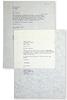 1970, 1977. Two typed notes signed, written seven years apart, each to Houghton Mifflin and regarding the work of Mary Lavin. Both letters give reasons for not being able to read the book in question in a timely enough manner to provide publicity praise, but each expresses admiration for Lavin's writing. The earlier note is signed in full as "Mary Frances Fisher." Both are folded for mailing, else fine. A couple of nice comments on Lavin's writing by Fisher, even if not suitable for blurbs.
[#036694]
SOLD
1970, 1977. Two typed notes signed, written seven years apart, each to Houghton Mifflin and regarding the work of Mary Lavin. Both letters give reasons for not being able to read the book in question in a timely enough manner to provide publicity praise, but each expresses admiration for Lavin's writing. The earlier note is signed in full as "Mary Frances Fisher." Both are folded for mailing, else fine. A couple of nice comments on Lavin's writing by Fisher, even if not suitable for blurbs.
[#036694]
SOLD
30.
FISHER, M.F.K.
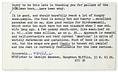 1971. A typed postcard signed offering very detailed feedback to the publisher of The Ski Country Cookbook by Ellen Stillman. ("A good recipe for Birchermuesli." "A few queasy short-cuts, like meat-loaf on p. 42." Etc.) With retained copy of a thank you to Fisher. As a cook and food writer, Fisher was well-equipped to comment knowledgeably on the cookbook, and she did. Staple in upper left corner, else fine.
[#036695]
SOLD
1971. A typed postcard signed offering very detailed feedback to the publisher of The Ski Country Cookbook by Ellen Stillman. ("A good recipe for Birchermuesli." "A few queasy short-cuts, like meat-loaf on p. 42." Etc.) With retained copy of a thank you to Fisher. As a cook and food writer, Fisher was well-equipped to comment knowledgeably on the cookbook, and she did. Staple in upper left corner, else fine.
[#036695]
SOLD
31.
FORD, Richard
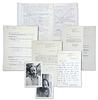 1980-1982. A large file of material related to the publication of Ford's second book, titled The Ultimate Good Luck (after, according to these pages, three previous title candidates). The lot begins with a 10-page handwritten author questionnaire. Ford skips a lot of the questions, but does answer how the idea for the book originated and whether he needed special research. He also supplies a very impressive list of authors (Jim Harrison, Peter Matthiessen, E.L. Doctorow, Raymond Carver, Tim O'Brien, Thomas McGuane, Richard Price, Joy Williams, Eudora Welty, Norman McLean, Geoffrey Wolff, Ward Just, Jayne Anne Phillips, Joyce Carol Oates, etc.) who may be interested in receiving advance copies. There is a typed note signed from Ford transmitting author photos (three are included here); and an autograph note signed stating his intention to read Kinsella's Shoeless Joe. There are about 20 pages of excisions from The Ultimate Good Luck that have all been re-typed elsewhere (i.e. the revised pages are not included), but many of Ford's changes are in evidence and these are apparently initialed by him (p. 138). From the above roster of authors, included here is a typed note signed from Tim O'Brien with praise for the book, as well as a photocopy of a longer letter from O'Brien to Ford, and a photocopy of an apparently unpublished 3-page review of the book by Raymond Carver, in which he compares the book to Malcolm Lowry's Under the Volcano and Graham Greene's The Power and the Glory. Additionally, there are approximately a dozen internal memos and retained letters; along with publicity plans; the invitation and guest list for the publication party; a list of recipients for complimentary copies; Ford's bio; a proof dust jacket; and a small collection of published reviews. The Ultimate Good Luck didn't bring Ford or the publisher the success that they had hoped for, and even seem to have expected. His next book was published as a paperback in a newly established Random House line, and was the precursor to the 1996 book, Independence Day, which won the Pulitzer Prize. From that point forward, Richard Ford was universally considered a major American author. The lot is near fine.
[#036696]
SOLD
1980-1982. A large file of material related to the publication of Ford's second book, titled The Ultimate Good Luck (after, according to these pages, three previous title candidates). The lot begins with a 10-page handwritten author questionnaire. Ford skips a lot of the questions, but does answer how the idea for the book originated and whether he needed special research. He also supplies a very impressive list of authors (Jim Harrison, Peter Matthiessen, E.L. Doctorow, Raymond Carver, Tim O'Brien, Thomas McGuane, Richard Price, Joy Williams, Eudora Welty, Norman McLean, Geoffrey Wolff, Ward Just, Jayne Anne Phillips, Joyce Carol Oates, etc.) who may be interested in receiving advance copies. There is a typed note signed from Ford transmitting author photos (three are included here); and an autograph note signed stating his intention to read Kinsella's Shoeless Joe. There are about 20 pages of excisions from The Ultimate Good Luck that have all been re-typed elsewhere (i.e. the revised pages are not included), but many of Ford's changes are in evidence and these are apparently initialed by him (p. 138). From the above roster of authors, included here is a typed note signed from Tim O'Brien with praise for the book, as well as a photocopy of a longer letter from O'Brien to Ford, and a photocopy of an apparently unpublished 3-page review of the book by Raymond Carver, in which he compares the book to Malcolm Lowry's Under the Volcano and Graham Greene's The Power and the Glory. Additionally, there are approximately a dozen internal memos and retained letters; along with publicity plans; the invitation and guest list for the publication party; a list of recipients for complimentary copies; Ford's bio; a proof dust jacket; and a small collection of published reviews. The Ultimate Good Luck didn't bring Ford or the publisher the success that they had hoped for, and even seem to have expected. His next book was published as a paperback in a newly established Random House line, and was the precursor to the 1996 book, Independence Day, which won the Pulitzer Prize. From that point forward, Richard Ford was universally considered a major American author. The lot is near fine.
[#036696]
SOLD
32.
FOSSEY, Dian
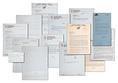 1976-1983. Thirteen pieces of correspondence (8 typed letters signed; 4 typed notes signed; and one autograph postcard signed) from Dian Fossey to her editors at Houghton Mifflin, from 1976 to 1983, the year Gorillas in the Mist was published. The correspondence begins with a letter in which Fossey admits she is finding the writing difficult, "as ten years of work seems about 9 1/2 too many for recollection's sake." Next comes a note as news bulletin: "ICARUS JUST BEAT MARCHESSA TO DEATH!! This book is going to sound like a Shakespearean play." There are several letters transmitting chapters, with various strategies for organization, including the ordering of events so that the reader will "feel for" the gorillas. She also speaks of teaching at Cornell; travel plans; reading The Selfish Gene (by Richard Dawkins); having an article due for National Geographic; being nominated for the Getty Wildlife Conservation Award; and being hospitalized with a ruptured disc and then pneumonia. Not long after, she writes of the death of (the gorilla) Bon Annee, also of pneumonia. In 1982: "I STILL DON'T HAVE A TITLE." In the letters following publication, Fossey sends detailed corrections for later printings; requests and responds to information about sales and marketing (she is "horrified" that a NYT ad was $6500: "Gosh, what that kind of money could mean to Karisoke [Research Centre] is not to be believed. There wouldn't be a poacher left within a five mile radius of camp!"); she takes issues with some erroneous reviews; and she offers her thoughts on her book tour. The final letter here concludes with her writing that she was thrilled that on tour she was "able to push gorillas, not myself or (uukgk) chimpanzees. What do you want to bet that most authors are 'tired' simply because they are trying to push their own images. Now, isn't that the most boring thing in the world?!" Fossey was murdered by machete in Rwanda two years later; her murder is officially "unsolved." Her work continues under the auspices of the Dian Fossey Gorilla Fund. Gorillas in the Mist was made into a Hollywood movie in 1988 starring Sigourney Weaver as Fossey, which was nominated for five Academy Awards. Two retained letters and an internal memo are included here; the lot is fine.
[#036697]
SOLD
1976-1983. Thirteen pieces of correspondence (8 typed letters signed; 4 typed notes signed; and one autograph postcard signed) from Dian Fossey to her editors at Houghton Mifflin, from 1976 to 1983, the year Gorillas in the Mist was published. The correspondence begins with a letter in which Fossey admits she is finding the writing difficult, "as ten years of work seems about 9 1/2 too many for recollection's sake." Next comes a note as news bulletin: "ICARUS JUST BEAT MARCHESSA TO DEATH!! This book is going to sound like a Shakespearean play." There are several letters transmitting chapters, with various strategies for organization, including the ordering of events so that the reader will "feel for" the gorillas. She also speaks of teaching at Cornell; travel plans; reading The Selfish Gene (by Richard Dawkins); having an article due for National Geographic; being nominated for the Getty Wildlife Conservation Award; and being hospitalized with a ruptured disc and then pneumonia. Not long after, she writes of the death of (the gorilla) Bon Annee, also of pneumonia. In 1982: "I STILL DON'T HAVE A TITLE." In the letters following publication, Fossey sends detailed corrections for later printings; requests and responds to information about sales and marketing (she is "horrified" that a NYT ad was $6500: "Gosh, what that kind of money could mean to Karisoke [Research Centre] is not to be believed. There wouldn't be a poacher left within a five mile radius of camp!"); she takes issues with some erroneous reviews; and she offers her thoughts on her book tour. The final letter here concludes with her writing that she was thrilled that on tour she was "able to push gorillas, not myself or (uukgk) chimpanzees. What do you want to bet that most authors are 'tired' simply because they are trying to push their own images. Now, isn't that the most boring thing in the world?!" Fossey was murdered by machete in Rwanda two years later; her murder is officially "unsolved." Her work continues under the auspices of the Dian Fossey Gorilla Fund. Gorillas in the Mist was made into a Hollywood movie in 1988 starring Sigourney Weaver as Fossey, which was nominated for five Academy Awards. Two retained letters and an internal memo are included here; the lot is fine.
[#036697]
SOLD
33.
FRASER, Sylvia
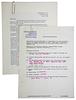 1988. A 4-page typed letter signed and a 6-page author questionnaire, both pertaining to the U.S. publication of My Father's House, Fraser's memoir of having been sexually abused by her father for more than a decade, memories of which she suppressed until her late 40s, after she was already a successful novelist: her first novel, Pandora, dealt with the theme of child sexual abuse. The letter takes up the subject of various people who may endorse the book (Marilyn French, Alice Walker, Susan Sontag, John Irving, and "Peggy Atwood," who has "been instrumental in selling German rights to my book." She also mentions Gloria Steinem and Dr. Cornelia Wilbur ("Sybil's" therapist). Fraser discusses tour plans ("As you know, the Canadian government supports artists abroad with money and special services") and says she is being flown to Hollywood to discuss writing a film script. She adds the names of potentially interested organizations and celebrities, including Cheryl Ladd, who "might see herself as the star of a film based on My Father's House." The questionnaire provides basic information but unfortunately frequently refers to biographical pages that are not present. Fraser does state here that she believes the strength of the book comes from being "written as a personal memoir by a writer who happens to be an incest survivor rather than by an incest survivor or a therapist." Near fine.
[#036698]
SOLD
1988. A 4-page typed letter signed and a 6-page author questionnaire, both pertaining to the U.S. publication of My Father's House, Fraser's memoir of having been sexually abused by her father for more than a decade, memories of which she suppressed until her late 40s, after she was already a successful novelist: her first novel, Pandora, dealt with the theme of child sexual abuse. The letter takes up the subject of various people who may endorse the book (Marilyn French, Alice Walker, Susan Sontag, John Irving, and "Peggy Atwood," who has "been instrumental in selling German rights to my book." She also mentions Gloria Steinem and Dr. Cornelia Wilbur ("Sybil's" therapist). Fraser discusses tour plans ("As you know, the Canadian government supports artists abroad with money and special services") and says she is being flown to Hollywood to discuss writing a film script. She adds the names of potentially interested organizations and celebrities, including Cheryl Ladd, who "might see herself as the star of a film based on My Father's House." The questionnaire provides basic information but unfortunately frequently refers to biographical pages that are not present. Fraser does state here that she believes the strength of the book comes from being "written as a personal memoir by a writer who happens to be an incest survivor rather than by an incest survivor or a therapist." Near fine.
[#036698]
SOLD
34.
GALBRAITH, John Kenneth
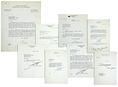 1954-1984. Three typed letters signed and four typed notes signed by Galbraith, spanning three decades and predominantly concerned with his books American Capitalism, Economics and the Public Purpose, Money, and The Anatomy of Power. The first letter, from 1954, agrees in principle to a German translation of American Capitalism and weighs the benefits of an updated edition. Subsequent internal memos reveal that Galbraith was unhappy with the terms negotiated for the German rights. In a 1969 note, Galbraith submits praise for Irving Bernstein's book [The Turbulent Years]. In a 1980 letter, Galbraith makes the case that his book Economics and the Public Purpose has attained standing equal to The Anatomy of Power and The New Industrial State. In 1983, he is arguing for a new edition of The Triumph. Also in 1983, a typed note signed by Katharine Graham of The Washington Post gratefully acknowledges receipt of a copy of The Anatomy of Power. In the final letter here, Galbraith suggests that the educational market for Anatomy of Power be explored. There are also five internal memos and retained letters providing a small amount of context. Apart from some publisher's notations, the lot is fine.
[#036699]
SOLD
1954-1984. Three typed letters signed and four typed notes signed by Galbraith, spanning three decades and predominantly concerned with his books American Capitalism, Economics and the Public Purpose, Money, and The Anatomy of Power. The first letter, from 1954, agrees in principle to a German translation of American Capitalism and weighs the benefits of an updated edition. Subsequent internal memos reveal that Galbraith was unhappy with the terms negotiated for the German rights. In a 1969 note, Galbraith submits praise for Irving Bernstein's book [The Turbulent Years]. In a 1980 letter, Galbraith makes the case that his book Economics and the Public Purpose has attained standing equal to The Anatomy of Power and The New Industrial State. In 1983, he is arguing for a new edition of The Triumph. Also in 1983, a typed note signed by Katharine Graham of The Washington Post gratefully acknowledges receipt of a copy of The Anatomy of Power. In the final letter here, Galbraith suggests that the educational market for Anatomy of Power be explored. There are also five internal memos and retained letters providing a small amount of context. Apart from some publisher's notations, the lot is fine.
[#036699]
SOLD
35.
GOODALL, Jane
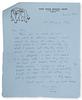 1974. Goodall writes from Gombe in Tanzania, to Dick McAdoo at Houghton Mifflin. She first expresses thanks about having been informed of an ethology award, awarded in abstentia, and about which she knew little. She also reports that "Shadow" (In the Shadow of Man) is selling well in England and hopes for its return to shelves in the U.S., and she mentions her show "Baboons" ("The Baboons of Gombe"). Signed, "Jane." Airmail letter, on Gombe Stream Research Centre stationery; near fine. Together with a retained copy of McAdoo's response, updating her on the paperback issue of In the Shadow of Man and also on her husband's (Hugo Van Lawick's) book Solo.
[#036700]
SOLD
1974. Goodall writes from Gombe in Tanzania, to Dick McAdoo at Houghton Mifflin. She first expresses thanks about having been informed of an ethology award, awarded in abstentia, and about which she knew little. She also reports that "Shadow" (In the Shadow of Man) is selling well in England and hopes for its return to shelves in the U.S., and she mentions her show "Baboons" ("The Baboons of Gombe"). Signed, "Jane." Airmail letter, on Gombe Stream Research Centre stationery; near fine. Together with a retained copy of McAdoo's response, updating her on the paperback issue of In the Shadow of Man and also on her husband's (Hugo Van Lawick's) book Solo.
[#036700]
SOLD
36.
GORDIMER, Nadine
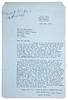 1974. An airmail letter, signed by Gordimer, in which she praises Paul Theroux's novel The Black House as his best since Jungle Lovers and offers a full paragraph promotional blurb. A very detailed and generous appraisal of Theroux's book, in which "he achieves something I don't think has ever been done successfully before: ...[he] has the detachment and trenchant daring to treat English society, mores, and even landscape as exotic." Publisher's notation across top; folded for mailing. Near fine.
[#036701]
SOLD
1974. An airmail letter, signed by Gordimer, in which she praises Paul Theroux's novel The Black House as his best since Jungle Lovers and offers a full paragraph promotional blurb. A very detailed and generous appraisal of Theroux's book, in which "he achieves something I don't think has ever been done successfully before: ...[he] has the detachment and trenchant daring to treat English society, mores, and even landscape as exotic." Publisher's notation across top; folded for mailing. Near fine.
[#036701]
SOLD
37.
GREENE, Graham
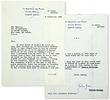 1987. A typed letter signed by Greene, written to the editor of The Commonweal lengthily denying the published account by Christopher Buckley regarding Greene and the circumstances surrounding his attendance at a Mass by Padre Pio. Greene goes point by point through half a dozen falsehoods and says he trusts "the lies in this story will be corrected before it appears in book form." (The book is Once a Catholic.) The letter is typed on two 6x9 pages; folding for mailing; else fine.
[#036702]
SOLD
1987. A typed letter signed by Greene, written to the editor of The Commonweal lengthily denying the published account by Christopher Buckley regarding Greene and the circumstances surrounding his attendance at a Mass by Padre Pio. Greene goes point by point through half a dozen falsehoods and says he trusts "the lies in this story will be corrected before it appears in book form." (The book is Once a Catholic.) The letter is typed on two 6x9 pages; folding for mailing; else fine.
[#036702]
SOLD
38.
HAMPL, Patricia
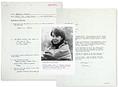 1982-1983. A photocopy of an 11-page author questionnaire Hampl completed in 1982, after publication of her memoir A Romantic Education and just prior to publication of Resort and Other Poems, in which she speaks about "Resort" as a "long meditative poem," "an account of a retreat," with themes of "loneliness vs. solitude." When she submits a list of nine people who might comment on the book if sent galleys, Hampl also notes her reasons, from "know personally" (Philip Levine, Sandra McPherson, and Thomas McGrath), to those she has met (Adrienne Rich, Gerald Stern), to those she simply admires (Carolyn Forche, Linda Gregg, Mona VanDuyn, William Stafford, Galway Kinnell). In a 1983 typed letter signed, she submits information for the acknowledgments page (not included), and mentions that the cover of "A Rom Ed" is growing on her, perhaps referring to a later edition, as she mentions a new typeface. Hampl's publicity photo for A Romantic Education is also included. The lot is near fine.
[#036703]
SOLD
1982-1983. A photocopy of an 11-page author questionnaire Hampl completed in 1982, after publication of her memoir A Romantic Education and just prior to publication of Resort and Other Poems, in which she speaks about "Resort" as a "long meditative poem," "an account of a retreat," with themes of "loneliness vs. solitude." When she submits a list of nine people who might comment on the book if sent galleys, Hampl also notes her reasons, from "know personally" (Philip Levine, Sandra McPherson, and Thomas McGrath), to those she has met (Adrienne Rich, Gerald Stern), to those she simply admires (Carolyn Forche, Linda Gregg, Mona VanDuyn, William Stafford, Galway Kinnell). In a 1983 typed letter signed, she submits information for the acknowledgments page (not included), and mentions that the cover of "A Rom Ed" is growing on her, perhaps referring to a later edition, as she mentions a new typeface. Hampl's publicity photo for A Romantic Education is also included. The lot is near fine.
[#036703]
SOLD
39.
HEAT MOON, William Least
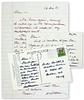 1991-1992. Four pieces of correspondence (one autograph letter signed; two autograph postcards signed; and one autograph note signed), all having to do with his contributing a foreword to a new edition of Walter McClintock's Old Indian Trails. Beforehand, Heat Moon addresses available research material; afterward, he points out a typo that got through. Fine.
[#036704]
SOLD
1991-1992. Four pieces of correspondence (one autograph letter signed; two autograph postcards signed; and one autograph note signed), all having to do with his contributing a foreword to a new edition of Walter McClintock's Old Indian Trails. Beforehand, Heat Moon addresses available research material; afterward, he points out a typo that got through. Fine.
[#036704]
SOLD
40.
(JOHNSON, Joyce)
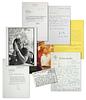 1982-1983. A small archive of praise from other writers for Joyce Johnson and Minor Characters, her memoir of her time with Jack Kerouac and the men and women of the Beat Generation. Compiled by Nan Talese at Houghton Mifflin. Typed and autograph letters signed by E.L. Doctorow, Hilma Wolitzer, Susan Brownmiller, Jill Robinson, Jerome Charyn, and Barbara Probst Solomon. A retained copy of Talese's letter of thanks to each writer is stapled to each letter. Together with an author photo of Johnson; a proof of the dust jacket; and a 1" thick file of reviews of the published book, with a retained letter transmitting copies to Johnson. From Solomon's letter: "I had always hoped we would have a woman's insight on that period, until now almost exclusively explained to us by men." All of the writers were of Joyce Johnson's generation, and all were avid in their praise of her work in this memoir; since the moment of its publication, her book has been seen as a fresh perspective on the Beats, and is itself anything but "minor." The group of reviews includes some surprising ones -- Philip Gold of the Institute for Foreign Policy Analysis reviewing it for Washington Monthly, far out of his field but surprisingly affected by it -- and also includes an interview with the author. The lot is near fine.
[#036705]
SOLD
1982-1983. A small archive of praise from other writers for Joyce Johnson and Minor Characters, her memoir of her time with Jack Kerouac and the men and women of the Beat Generation. Compiled by Nan Talese at Houghton Mifflin. Typed and autograph letters signed by E.L. Doctorow, Hilma Wolitzer, Susan Brownmiller, Jill Robinson, Jerome Charyn, and Barbara Probst Solomon. A retained copy of Talese's letter of thanks to each writer is stapled to each letter. Together with an author photo of Johnson; a proof of the dust jacket; and a 1" thick file of reviews of the published book, with a retained letter transmitting copies to Johnson. From Solomon's letter: "I had always hoped we would have a woman's insight on that period, until now almost exclusively explained to us by men." All of the writers were of Joyce Johnson's generation, and all were avid in their praise of her work in this memoir; since the moment of its publication, her book has been seen as a fresh perspective on the Beats, and is itself anything but "minor." The group of reviews includes some surprising ones -- Philip Gold of the Institute for Foreign Policy Analysis reviewing it for Washington Monthly, far out of his field but surprisingly affected by it -- and also includes an interview with the author. The lot is near fine.
[#036705]
SOLD
41.
KINNELL, Galway
 1959-1980. An archive of correspondence spanning Kinnell's first two decades with Houghton Mifflin and including an author questionnaire (1959) and 14+ pieces of correspondence (one autograph letter signed; one typed letter signed; two autograph notes signed; 5 typed notes signed; 4 autograph postcards signed; and one typed postcard signed). The author questionnaire is incompletely but rather amusingly filled out (How much do you revise? "Much."; Did you encounter any difficulties while writing it? "!"). Kinnell does provide biographical information and a list of favorite authors, as well as an ample list of people who may be interested in his first book, which at this point seems to have been titled "Seven Streams." Next there is a brief publisher's biography (1963), with a hand-written Kinnell postscript ("I'm ashamed to say I don't believe anything much has happened to me since this was written"); a 5-page handwritten list of chosen recipients (Hayden Carruth, Robert Bly, Philip Roth, W.S. Merwin, Richard Eberhart, etc.) for complimentary copies of his 1966 novel Black Light; and a 1968 blurb for Charles Bell's The Half Gods. There are two typed postcards signed from Louis Untermeyer, regarding Body Rags (1967) and The Book of Nightmares (1971); there is an autograph postcard signed from Richard Howard (1971) saying he'll be reviewing the book [Body Rags] for The Partisan Review. Many of the later notes and postcards are requests that photos of Kinnell be sent out. Also included is a copy of Kinnell's The Fundamental Project of Technology, which was presented as the Phi Beta Kappa Poem during Harvard's Commencement Week, 1983; it contains a handwritten correction to a typo. Lastly, there are a handful of copies of retained letters and publisher's memos. Kinnell's 1982 collection, Selected Poems, won the Pulitzer Prize and the National Book Award, and was included in Harold Bloom's The Western Canon. Several of Kinnell's pages bear publisher's notations, mostly indicating tasks completed; the lot is near fine.
[#036706]
SOLD
1959-1980. An archive of correspondence spanning Kinnell's first two decades with Houghton Mifflin and including an author questionnaire (1959) and 14+ pieces of correspondence (one autograph letter signed; one typed letter signed; two autograph notes signed; 5 typed notes signed; 4 autograph postcards signed; and one typed postcard signed). The author questionnaire is incompletely but rather amusingly filled out (How much do you revise? "Much."; Did you encounter any difficulties while writing it? "!"). Kinnell does provide biographical information and a list of favorite authors, as well as an ample list of people who may be interested in his first book, which at this point seems to have been titled "Seven Streams." Next there is a brief publisher's biography (1963), with a hand-written Kinnell postscript ("I'm ashamed to say I don't believe anything much has happened to me since this was written"); a 5-page handwritten list of chosen recipients (Hayden Carruth, Robert Bly, Philip Roth, W.S. Merwin, Richard Eberhart, etc.) for complimentary copies of his 1966 novel Black Light; and a 1968 blurb for Charles Bell's The Half Gods. There are two typed postcards signed from Louis Untermeyer, regarding Body Rags (1967) and The Book of Nightmares (1971); there is an autograph postcard signed from Richard Howard (1971) saying he'll be reviewing the book [Body Rags] for The Partisan Review. Many of the later notes and postcards are requests that photos of Kinnell be sent out. Also included is a copy of Kinnell's The Fundamental Project of Technology, which was presented as the Phi Beta Kappa Poem during Harvard's Commencement Week, 1983; it contains a handwritten correction to a typo. Lastly, there are a handful of copies of retained letters and publisher's memos. Kinnell's 1982 collection, Selected Poems, won the Pulitzer Prize and the National Book Award, and was included in Harold Bloom's The Western Canon. Several of Kinnell's pages bear publisher's notations, mostly indicating tasks completed; the lot is near fine.
[#036706]
SOLD
42.
KINSELLA, W.P.
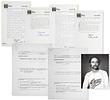 1981-1985. The archive begins in late 1981, several months prior to the April, 1982 release of Shoeless Joe, and includes three typed letters signed, two typed notes signed, two author questionnaires (completed 4 years apart); and publicity photos. In the first letter (November, 1981), Kinsella suggests interviews he could do while in Toronto and Lincoln, Nebraska. ("Is book scheduled for mid-March release or did I dream that? Inundated in drivel. Not writing. Have done 8 readings in last 7 weeks.") In a 1982 author questionnaire, Kinsella provides biographical information and answers questions about the origin of the idea for his novel and the research needed; his hobbies ("Travel 10-15,000 miles each summer to view baseball games from one end of the continent to the other. Favorite teams Seattle Mariners and Minnesota Twins. Hate those Yankees."); names of people who may want to give advance comment (John Irving, Bernard Malamud, Margaret Atwood, Anne Tyler, Richard Brautigan, Roger Angell, George Steinbrenner, and Howard Cosell, among others); thoughts on promoting the book; etc. In the remaining four letters, all from March of 1982, he laments having not felt well while in NY (although he was able to see two plays and offers his reviews); he agrees to a reading for the Canadian Booksellers Association; and he writes more about proposed tour cities and baseball stadiums to be visited, concluding with his wife's plans to deck out her car with Shoeless Joe Author's Tour promotional posters. The second author questionnaire (1985) coincides with the planned release of The Iowa Baseball Confederacy. Information covered here includes his previous jobs held; his hobbies (a "search for the perfect baseball story"); a list of people who should receive galleys (on which he includes himself, as he says he received no galley of Shoeless Joe); proposed jacket copy; etc. Finally, there are publicity photos for both The Iowa Baseball Confederacy and for Shoeless Joe, including an 8" x10" original print for Shoeless Joe. Shoeless Joe was the basis for the movie, Field of Dreams, which was nominated for three Academy Awards. The lot is near fine.
[#036707]
SOLD
1981-1985. The archive begins in late 1981, several months prior to the April, 1982 release of Shoeless Joe, and includes three typed letters signed, two typed notes signed, two author questionnaires (completed 4 years apart); and publicity photos. In the first letter (November, 1981), Kinsella suggests interviews he could do while in Toronto and Lincoln, Nebraska. ("Is book scheduled for mid-March release or did I dream that? Inundated in drivel. Not writing. Have done 8 readings in last 7 weeks.") In a 1982 author questionnaire, Kinsella provides biographical information and answers questions about the origin of the idea for his novel and the research needed; his hobbies ("Travel 10-15,000 miles each summer to view baseball games from one end of the continent to the other. Favorite teams Seattle Mariners and Minnesota Twins. Hate those Yankees."); names of people who may want to give advance comment (John Irving, Bernard Malamud, Margaret Atwood, Anne Tyler, Richard Brautigan, Roger Angell, George Steinbrenner, and Howard Cosell, among others); thoughts on promoting the book; etc. In the remaining four letters, all from March of 1982, he laments having not felt well while in NY (although he was able to see two plays and offers his reviews); he agrees to a reading for the Canadian Booksellers Association; and he writes more about proposed tour cities and baseball stadiums to be visited, concluding with his wife's plans to deck out her car with Shoeless Joe Author's Tour promotional posters. The second author questionnaire (1985) coincides with the planned release of The Iowa Baseball Confederacy. Information covered here includes his previous jobs held; his hobbies (a "search for the perfect baseball story"); a list of people who should receive galleys (on which he includes himself, as he says he received no galley of Shoeless Joe); proposed jacket copy; etc. Finally, there are publicity photos for both The Iowa Baseball Confederacy and for Shoeless Joe, including an 8" x10" original print for Shoeless Joe. Shoeless Joe was the basis for the movie, Field of Dreams, which was nominated for three Academy Awards. The lot is near fine.
[#036707]
SOLD
43.
KNIGHT, Etheridge
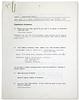 1980. An 8-page author questionnaire filled out, in both type and pencil, by Knight prior to the publication of his collection Born of a Woman. Knight declines to answer the majority of the questions posed, but is creative about the ones he does answer: Is there a title you prefer used with your name? "Poet Ether." Avocations or hobbies? "My avocation is Freedom; my hobby is freedom." A summary of the book? "I hope my poems are experiential, essential, and communicative. Experiential in that they are the record of the experience of one Black Male Human/Being living in the United States of America NOW. Essential in that they are the essence of ME, flowing in the UniVerse, from my/self/through the Poem to the People, and back to ME," etc. For people who might provide comment, Knight lists Gwendolyn Brooks, Robert Bly, Amiri Baraka, Denise Levertov, and Alice Walker. Brooks eventually wrote the book's preface. Previously folded; publisher's notations (crossing out the above names as they were sent galleys); near fine.
[#036708]
SOLD
1980. An 8-page author questionnaire filled out, in both type and pencil, by Knight prior to the publication of his collection Born of a Woman. Knight declines to answer the majority of the questions posed, but is creative about the ones he does answer: Is there a title you prefer used with your name? "Poet Ether." Avocations or hobbies? "My avocation is Freedom; my hobby is freedom." A summary of the book? "I hope my poems are experiential, essential, and communicative. Experiential in that they are the record of the experience of one Black Male Human/Being living in the United States of America NOW. Essential in that they are the essence of ME, flowing in the UniVerse, from my/self/through the Poem to the People, and back to ME," etc. For people who might provide comment, Knight lists Gwendolyn Brooks, Robert Bly, Amiri Baraka, Denise Levertov, and Alice Walker. Brooks eventually wrote the book's preface. Previously folded; publisher's notations (crossing out the above names as they were sent galleys); near fine.
[#036708]
SOLD
44.
KOSINSKI, Jerzy
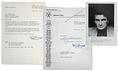 1975-1976. One typed letter signed and one typed note signed, both regarding corrections needed in the proofs of his novel Cockpit. Attached to the second letter are copies of several pages of proof sheets, with corrections. An additional typed letter signed from 1976 addresses travel plans and schedule changes. A publicity photo for Cockpit, as well as one for The Painted Bird and one for Blind Date are included. Editorial checkmark across the text of the typed note; the lot is near fine.
[#036709]
SOLD
1975-1976. One typed letter signed and one typed note signed, both regarding corrections needed in the proofs of his novel Cockpit. Attached to the second letter are copies of several pages of proof sheets, with corrections. An additional typed letter signed from 1976 addresses travel plans and schedule changes. A publicity photo for Cockpit, as well as one for The Painted Bird and one for Blind Date are included. Editorial checkmark across the text of the typed note; the lot is near fine.
[#036709]
SOLD
45.
LAVIN, Mary
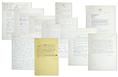 1971-1977. Two autograph letters signed (4 pp. and 2 pp.) and two typed letters signed (4 pp. and 1 p.), written to her contacts at her U.S. publisher, Houghton Mifflin. In the first letter, from 1971 (just prior to the publication of her Collected Stories, although the latter is mis-dated "1970"), Lavin goes to great lengths to help inform the publicity for her book, hoping that it will reflect her seriousness of intent and noting that what she looks for in a short story is "such light it may throw on the mysteries of existence"; as such the reader does not need to know what the included stories are about, but rather "the tradition from which I stem." She wonders why the attention paid to her has been less than that of Jean Stafford, Eudora Welty, Katherine Anne Porter, and although she acknowledges that she has benefited from neglect, she needs this book to receive attention as more than one to share with a friend. "I would NEVER think of a book as something nice or pleasant to give to a friend. I would think of any book I valued almost as I would think of a loaded pistol with which the other person might well blow out his brains if he wasn't prepared..." The correspondence resumes in 1977, as HM was publishing The Shrine and Other Stories, with a scathing letter on the "namby-pambiness" of the suggested author bio, asking that more mention be made of the awards she has won. There are an additional two letters commenting on her author photo and repeatedly asking that mention of her novels be omitted: "...just plug my position in the world of the short story, translated into almost every major language etc." Also included here are transcriptions of her two hand-written letters; a heavily hand-corrected typewritten biographical statement (likely not by Lavin), two retained copies of letters to her, and the author's CV. The lot is near fine.
[#036710]
SOLD
1971-1977. Two autograph letters signed (4 pp. and 2 pp.) and two typed letters signed (4 pp. and 1 p.), written to her contacts at her U.S. publisher, Houghton Mifflin. In the first letter, from 1971 (just prior to the publication of her Collected Stories, although the latter is mis-dated "1970"), Lavin goes to great lengths to help inform the publicity for her book, hoping that it will reflect her seriousness of intent and noting that what she looks for in a short story is "such light it may throw on the mysteries of existence"; as such the reader does not need to know what the included stories are about, but rather "the tradition from which I stem." She wonders why the attention paid to her has been less than that of Jean Stafford, Eudora Welty, Katherine Anne Porter, and although she acknowledges that she has benefited from neglect, she needs this book to receive attention as more than one to share with a friend. "I would NEVER think of a book as something nice or pleasant to give to a friend. I would think of any book I valued almost as I would think of a loaded pistol with which the other person might well blow out his brains if he wasn't prepared..." The correspondence resumes in 1977, as HM was publishing The Shrine and Other Stories, with a scathing letter on the "namby-pambiness" of the suggested author bio, asking that more mention be made of the awards she has won. There are an additional two letters commenting on her author photo and repeatedly asking that mention of her novels be omitted: "...just plug my position in the world of the short story, translated into almost every major language etc." Also included here are transcriptions of her two hand-written letters; a heavily hand-corrected typewritten biographical statement (likely not by Lavin), two retained copies of letters to her, and the author's CV. The lot is near fine.
[#036710]
SOLD
46.
LEGUIN, Ursula
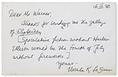 1980. An autograph postcard signed by LeGuin, sending words of praise in response to receiving galleys of Harlan Ellison's short story collection Shatterday: "Speculative fiction without Harlan Ellison would be like the fourth of July without fireworks." Publisher's penciled brackets around quote to be excerpted; near fine. Ellison later narrated an audio version of LeGuin's A Wizard of Earthsea.
[#036711]
SOLD
1980. An autograph postcard signed by LeGuin, sending words of praise in response to receiving galleys of Harlan Ellison's short story collection Shatterday: "Speculative fiction without Harlan Ellison would be like the fourth of July without fireworks." Publisher's penciled brackets around quote to be excerpted; near fine. Ellison later narrated an audio version of LeGuin's A Wizard of Earthsea.
[#036711]
SOLD
47.
MACLEISH, Archibald
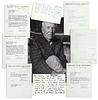 1962-1977. Eight pieces of correspondence to his publisher from MacLeish, three time Pulitzer Prize winner (two for Poetry, one for Drama); National Book Award winner; Tony Award Winner; Librarian of Congress; and the recipient of the Presidential Medal of Freedom. There are a total of four typed notes signed (although one is apparently signed by a secretary); two autograph postcards signed; one typed letter signed; and one typed blurb signed, with an autograph note signed below. The file begins with MacLeish submitting the certificate of copyright (not present) for his poem read at the Lincoln Memorial on the centennial of the Emancipation Proclamation. The middle group of letters concern poetry selections, the poem order, and the index for his volume of Collected Poems. In 1976, MacLeish submits lengthy praise for A. Poulin's translation of Rilke's Duino Elegies. With the final postcard here, MacLeish reports his progress on, apparently, his collection of essays and autobiographical writings Riders on the Earth. There are several retained copies of letters to MacLeish, and one author photo. Apart from the publisher's notations on one of the notes; the lot is fine. A nice grouping of correspondence with good literary content by one of the leading American men of letters of the 20th century.
[#036712]
SOLD
1962-1977. Eight pieces of correspondence to his publisher from MacLeish, three time Pulitzer Prize winner (two for Poetry, one for Drama); National Book Award winner; Tony Award Winner; Librarian of Congress; and the recipient of the Presidential Medal of Freedom. There are a total of four typed notes signed (although one is apparently signed by a secretary); two autograph postcards signed; one typed letter signed; and one typed blurb signed, with an autograph note signed below. The file begins with MacLeish submitting the certificate of copyright (not present) for his poem read at the Lincoln Memorial on the centennial of the Emancipation Proclamation. The middle group of letters concern poetry selections, the poem order, and the index for his volume of Collected Poems. In 1976, MacLeish submits lengthy praise for A. Poulin's translation of Rilke's Duino Elegies. With the final postcard here, MacLeish reports his progress on, apparently, his collection of essays and autobiographical writings Riders on the Earth. There are several retained copies of letters to MacLeish, and one author photo. Apart from the publisher's notations on one of the notes; the lot is fine. A nice grouping of correspondence with good literary content by one of the leading American men of letters of the 20th century.
[#036712]
SOLD
48.
MARKUS, Julia
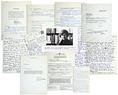 1978-1980. Seven pieces of correspondence (three autograph letters signed; three autograph postcards signed; one typed note signed) and two completed author questionnaires with accompanying C.V.s, all dating from the time of publication of her novels Uncle, which won a Houghton Mifflin Literary Fellowship Award, and American Rose. The lot begins with Markus' 1978 author questionnaire, in which she answers all demographic questions, as well as positions held, colleges attended, and previous books published. She also supplies her hobbies (literary history, Italian films, swimming); her influences (Browning, Years, Fellini, George Eliot, Henry James, C.P. Snow, etc.); the names of those who might provide comment; and important points to emphasize in the promotion of Uncle. Her letters touch on publicity, reviews, gratitude for her publisher, her reading (The Thin Man); her writing (proceeding well after attending the Nashville Conference); and an endorsement for Nina Schneider's The Woman Who Lived in A Prologue. A publicity photo of the author is included. The later author questionnaire [1980] is a photocopy, with an attached C.V.: with this questionnaire, Markus is more spare with demographics, but she provides more information about the origin of her novel American Rose, as well as the research conducted, her potential market, and suggested angles for promotion. "America in the present, despite its similarities to Rome in its decline, is an exhilarating place to be. Maybe because the American Dream never worked out, maybe because we are in a decline of power, maybe because of the strength of our individual imaginations, I feel we are on new ground..." Also included are a typed note signed from Norman Mailer and an autograph postcard signed from Susan Fromberg Schaeffer: each politely declines to offer a blurb for American Rose, but Schaeffer does offer to review it when it comes out. There is also a form from City Lights Books granting permission for an excerpt from Allen Ginsberg's Kaddish to be used in American Rose, which is signed by Markus. The lot is fine.
[#036713]
SOLD
1978-1980. Seven pieces of correspondence (three autograph letters signed; three autograph postcards signed; one typed note signed) and two completed author questionnaires with accompanying C.V.s, all dating from the time of publication of her novels Uncle, which won a Houghton Mifflin Literary Fellowship Award, and American Rose. The lot begins with Markus' 1978 author questionnaire, in which she answers all demographic questions, as well as positions held, colleges attended, and previous books published. She also supplies her hobbies (literary history, Italian films, swimming); her influences (Browning, Years, Fellini, George Eliot, Henry James, C.P. Snow, etc.); the names of those who might provide comment; and important points to emphasize in the promotion of Uncle. Her letters touch on publicity, reviews, gratitude for her publisher, her reading (The Thin Man); her writing (proceeding well after attending the Nashville Conference); and an endorsement for Nina Schneider's The Woman Who Lived in A Prologue. A publicity photo of the author is included. The later author questionnaire [1980] is a photocopy, with an attached C.V.: with this questionnaire, Markus is more spare with demographics, but she provides more information about the origin of her novel American Rose, as well as the research conducted, her potential market, and suggested angles for promotion. "America in the present, despite its similarities to Rome in its decline, is an exhilarating place to be. Maybe because the American Dream never worked out, maybe because we are in a decline of power, maybe because of the strength of our individual imaginations, I feel we are on new ground..." Also included are a typed note signed from Norman Mailer and an autograph postcard signed from Susan Fromberg Schaeffer: each politely declines to offer a blurb for American Rose, but Schaeffer does offer to review it when it comes out. There is also a form from City Lights Books granting permission for an excerpt from Allen Ginsberg's Kaddish to be used in American Rose, which is signed by Markus. The lot is fine.
[#036713]
SOLD
49.
MARTIN, Valerie
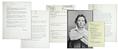 1986-1988. Publication material pertaining to two of Martin's books: A Recent Martyr and The Consolation of Nature, and a photocopy of an essay. A Recent Martyr is represented by a press release, an author photo, and an author questionnaire, which for the most part refers to an enclosed C.V., but does add the following, when she is asked about avocations or hobbies: "I have no hobbies. This could be significant." The Consolation of Nature is represented by the publisher's type specifications and a photocopy of a letter from Martin with a list of people she would like to receive review copies, as well as suggesting cities for book signings. Lastly, there is a photocopy of the typescript of a 9-page essay here titled "Where Do Stories Come From," which was published, with many revisions, as "Waiting for the Story to Start" in The New York Times Book Review in 1988. The lot is fine. Martin's novel, Property, won the Orange Prize for Fiction, and her novel Mary Reilly was a Nebula Award and World Fantasy Award nominee, and the basis for a film.
[#036714]
SOLD
1986-1988. Publication material pertaining to two of Martin's books: A Recent Martyr and The Consolation of Nature, and a photocopy of an essay. A Recent Martyr is represented by a press release, an author photo, and an author questionnaire, which for the most part refers to an enclosed C.V., but does add the following, when she is asked about avocations or hobbies: "I have no hobbies. This could be significant." The Consolation of Nature is represented by the publisher's type specifications and a photocopy of a letter from Martin with a list of people she would like to receive review copies, as well as suggesting cities for book signings. Lastly, there is a photocopy of the typescript of a 9-page essay here titled "Where Do Stories Come From," which was published, with many revisions, as "Waiting for the Story to Start" in The New York Times Book Review in 1988. The lot is fine. Martin's novel, Property, won the Orange Prize for Fiction, and her novel Mary Reilly was a Nebula Award and World Fantasy Award nominee, and the basis for a film.
[#036714]
SOLD
50.
MAY, Julian
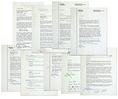 1980-1982. An extensive correspondence file (15 typed letters signed and three typed notes signed), as well as an author questionnaire, giving a detailed play-by-play of the launching of May's "Exile" series, beginning with The Many-Colored Land. Note that Julian May was also known as Judy, and that she married SF editor Ted Ditky, and May uses a combination of first and last names in these letters. However, the first two entries here are formal letters of negotiation for the publication of "The Exiles," written by Ted Ditky on May's behalf. The first letter by May herself initiates the process of renaming the series' first book. There follows an unsigned contract. Her second letter responds, at length, to suggested editorial changes (specifically, to an expansion on the destruction of Finiah), and she also makes a case for including introductory recaps in the later books. The next letters continue with the subject of the title, but also discusses the chapter layouts, the maps, and the need to reach a new audience, beyond those who had only previously been exposed to SF which "takes itself very seriously for no good reason." May even suggests that those who are slated to receive proofs be chosen for their sense of humor, and she suggests Silverberg, Ellison, Bester, Sturgeon, Asimov, and Zelazny. At one point, she begs her editor to be vague about where she lives, as SF fans are "uninhibited," and she doesn't want to have to "move to Hawaii to get away from them as Frank Herbert is doing." She resists being personally used for publicity, calling herself "snotty, profane, impatient," and she requests that there be no photo of her on the first book, so as to "minimize the Female SF Author Curse." In the author questionnaire (which is a photocopy, but which has been edited in pencil in an unknown hand), May is terse in answers about herself or ideas for publicity, but she answers at length questions about the book itself and its writing. The Many-Colored Land is an "adventure thriller"; below that, a "psychological study of the characters"; below that, "a mythic-symbolic fabric with folklorish analogs"; below that, "a philosophic statement." "And you just thought it was good dirty fun!" May's championing of her vision for the book continues in a letter with a detailed 6-point objection to the suggested dust jacket art, petitioning for something that would convey that this book "is an entertainment for the thinking adult. It will take you out of the mundane world and into a many-colored land of fantasy," as opposed to the proposed art, with its "blatantly sexist female ass waving focal point from dead center," etc. Her next letter conveys a photocopy of a letter from Joe Haldeman offering praise ("...combining a meticulously reconstructed prehistoric Earth with one of the best-thought-out futures I've ever encountered in science fiction..."). Once the book is published, the conversation turns to reviews, and then to the timing of the next two books in the series, The Golden Torc and The Nonborn King, with a full page devoted to the merits of "nonborn" being unhyphenated. Several of the letters bear publisher's comments, with two of them having full draft responses written out on them; otherwise the lot is fine. A charming and insightful trove of correspondence.
[#036715]
SOLD
1980-1982. An extensive correspondence file (15 typed letters signed and three typed notes signed), as well as an author questionnaire, giving a detailed play-by-play of the launching of May's "Exile" series, beginning with The Many-Colored Land. Note that Julian May was also known as Judy, and that she married SF editor Ted Ditky, and May uses a combination of first and last names in these letters. However, the first two entries here are formal letters of negotiation for the publication of "The Exiles," written by Ted Ditky on May's behalf. The first letter by May herself initiates the process of renaming the series' first book. There follows an unsigned contract. Her second letter responds, at length, to suggested editorial changes (specifically, to an expansion on the destruction of Finiah), and she also makes a case for including introductory recaps in the later books. The next letters continue with the subject of the title, but also discusses the chapter layouts, the maps, and the need to reach a new audience, beyond those who had only previously been exposed to SF which "takes itself very seriously for no good reason." May even suggests that those who are slated to receive proofs be chosen for their sense of humor, and she suggests Silverberg, Ellison, Bester, Sturgeon, Asimov, and Zelazny. At one point, she begs her editor to be vague about where she lives, as SF fans are "uninhibited," and she doesn't want to have to "move to Hawaii to get away from them as Frank Herbert is doing." She resists being personally used for publicity, calling herself "snotty, profane, impatient," and she requests that there be no photo of her on the first book, so as to "minimize the Female SF Author Curse." In the author questionnaire (which is a photocopy, but which has been edited in pencil in an unknown hand), May is terse in answers about herself or ideas for publicity, but she answers at length questions about the book itself and its writing. The Many-Colored Land is an "adventure thriller"; below that, a "psychological study of the characters"; below that, "a mythic-symbolic fabric with folklorish analogs"; below that, "a philosophic statement." "And you just thought it was good dirty fun!" May's championing of her vision for the book continues in a letter with a detailed 6-point objection to the suggested dust jacket art, petitioning for something that would convey that this book "is an entertainment for the thinking adult. It will take you out of the mundane world and into a many-colored land of fantasy," as opposed to the proposed art, with its "blatantly sexist female ass waving focal point from dead center," etc. Her next letter conveys a photocopy of a letter from Joe Haldeman offering praise ("...combining a meticulously reconstructed prehistoric Earth with one of the best-thought-out futures I've ever encountered in science fiction..."). Once the book is published, the conversation turns to reviews, and then to the timing of the next two books in the series, The Golden Torc and The Nonborn King, with a full page devoted to the merits of "nonborn" being unhyphenated. Several of the letters bear publisher's comments, with two of them having full draft responses written out on them; otherwise the lot is fine. A charming and insightful trove of correspondence.
[#036715]
SOLD
51.
McGUANE, Tom
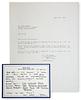 1992. One typed note signed and one autograph postcard signed. The former transmits an introduction (not present), presumably for The Best American Sports Writing 1992, which McGuane edited. In the latter, McGuane names three titles that he believes "very strongly" should be in print again: Archie Carr's The Windward Road; William Beebe's The Arcturus Adventure, and Edward Hoagland's Notes From the Century Before. Both items fine.
[#036716]
SOLD
1992. One typed note signed and one autograph postcard signed. The former transmits an introduction (not present), presumably for The Best American Sports Writing 1992, which McGuane edited. In the latter, McGuane names three titles that he believes "very strongly" should be in print again: Archie Carr's The Windward Road; William Beebe's The Arcturus Adventure, and Edward Hoagland's Notes From the Century Before. Both items fine.
[#036716]
SOLD
52.
MCINTYRE, Vonda
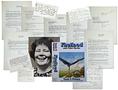 1977-1980. More than two dozen pieces of correspondence from McIntyre to her publisher during the time surrounding the release of her Hugo and Nebula Award winning novel Dreamsnake and her story collection Fireflood, along with a completed author questionnaire, as well as words of praise from Ursula LeGuin, Marge Piercy, Kenneth Rexroth, and Roger Zelazny. The early letters and the author questionnaire find McIntyre trying to decide on the Dreamsnake title and attempting to steer the marketing for her book away from "adolescent male fantasy" science fiction and toward women and feminists. It's in this early stage that Rexroth asks to read the book, and LeGuin and Piercy submit blurbs (with LeGuin equating the book to a mountain stream, while Piercy calls it complicated and kinky). The letters that follow take up issues such as author photos, reviewer copies, sci fi conventions and autograph parties, and the possibility of Dreamsnake promotional decals. The 1979 letters begin to deal with the stories to be included in Fireflood, as well as its artwork and promotion, and with Dreamsnake being nominated for the Hugo ("I don't expect it to win--I think Anne McCaffrey will take it for The White Dragon"). A second autograph postcard signed from Ursula LeGuin begs off submitting praise for Fireflood as she was the dedicatee of McIntyre's first book and featured with a blurb on the next, and wishes to avoid the "claque" effect. Piercy and Zelazny do come through here, submitting blurbs. After this comes the news of Fireflood stories being anthologized, including in Terry Carr's Best Science Fiction of the Year. In all, there are 21 typed letters signed; 4 typed notes signed; 1 typed postcard signed; and one autograph letter signed by McIntyre, as well as the author questionnaire, and the six notes from the four other authors. There are nearly 20 copies of retained letters or memos from the publisher; a publicity sheet for Dreamsnake; a proof jacket for Fireflood; and 5 author photos. About one-third of the letters have a small upper corner stain, not affecting text. Some of the letters bear publisher notations. The lot is near fine. A very interesting archive from the first decade in which women were publishing science fiction without disguising their gender by using initials or pseudonyms.
[#036717]
SOLD
1977-1980. More than two dozen pieces of correspondence from McIntyre to her publisher during the time surrounding the release of her Hugo and Nebula Award winning novel Dreamsnake and her story collection Fireflood, along with a completed author questionnaire, as well as words of praise from Ursula LeGuin, Marge Piercy, Kenneth Rexroth, and Roger Zelazny. The early letters and the author questionnaire find McIntyre trying to decide on the Dreamsnake title and attempting to steer the marketing for her book away from "adolescent male fantasy" science fiction and toward women and feminists. It's in this early stage that Rexroth asks to read the book, and LeGuin and Piercy submit blurbs (with LeGuin equating the book to a mountain stream, while Piercy calls it complicated and kinky). The letters that follow take up issues such as author photos, reviewer copies, sci fi conventions and autograph parties, and the possibility of Dreamsnake promotional decals. The 1979 letters begin to deal with the stories to be included in Fireflood, as well as its artwork and promotion, and with Dreamsnake being nominated for the Hugo ("I don't expect it to win--I think Anne McCaffrey will take it for The White Dragon"). A second autograph postcard signed from Ursula LeGuin begs off submitting praise for Fireflood as she was the dedicatee of McIntyre's first book and featured with a blurb on the next, and wishes to avoid the "claque" effect. Piercy and Zelazny do come through here, submitting blurbs. After this comes the news of Fireflood stories being anthologized, including in Terry Carr's Best Science Fiction of the Year. In all, there are 21 typed letters signed; 4 typed notes signed; 1 typed postcard signed; and one autograph letter signed by McIntyre, as well as the author questionnaire, and the six notes from the four other authors. There are nearly 20 copies of retained letters or memos from the publisher; a publicity sheet for Dreamsnake; a proof jacket for Fireflood; and 5 author photos. About one-third of the letters have a small upper corner stain, not affecting text. Some of the letters bear publisher notations. The lot is near fine. A very interesting archive from the first decade in which women were publishing science fiction without disguising their gender by using initials or pseudonyms.
[#036717]
SOLD
53.
McMILLAN, Terry
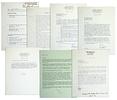 1986-1989. When her first novel, Mama, was published in 1987, McMillan reportedly wrote more than 3,000 letters to bookstores, colleges, African-American groups, etc., promoting her book; she also arranged her own 39-city book tour. Her efforts worked: Mama was re-printed twice in the first six weeks. This archive shows both the author's diligence and her enthusiasm, beginning with a May, 1986 author questionnaire, in which she has thoroughly answered all 27 questions, adding two appendices for extra space. A third appendix is included (of apparently 7, although #4-7 are absent here), in which McMillan provides a 4-page list of people who may provide blurbs, more than half of whom are asterisked as those she will ask herself. She follows this with her own 7-point plan for promotion; and then follows this with 23 detailed and pointed questions for the sales department (#10: "How can I find out who the HM sales representative for my book is and how he/she feels about my book, if they've read it or will read it before the sales meeting, and if they like it or are excited about it?"). In the first of five typed letters signed that are included here, McMillan posits an additional ten questions. At this point Nan Talese sends a reassuring letter, a copy of which is retained. On the same day, McMillan writes a letter disclosing that she has personally contacted 900-1000 places (libraries and book buyers and English Departments of Black colleges and major universities) and has plans to contact bookstores. The following month, she pens a letter apologizing to her publicist, apparently reacting to having been told that sending letters to bookstores had crossed into the sales department's territory; a copy of a second note offers an apology directly to the sales department. Also included: McMillan's CV, ca. 1987; a promotional brochure for Mama; a 1987 typed letter signed, written while on vacation; and a typed letter signed from 1989, after the first reviews of Disappearing Acts have come in and TriStar Pictures has optioned the movie rights (the film was eventually released by HBO in 2000). Largely as a result of her own promotion of her books -- and the fact that they dealt with an underrepresented demographic: middle class Black women, on their own -- McMillan's books became huge bestsellers -- one of them commanding what was thought to be the second largest sale of paperback rights at the time, with at least four of them being made into films. This archive shows her unending willingness to work on the nuts and bolts of publishing and promoting her work, in addition to doing the work itself: much of Mama was written at Yaddo and MacDowell and revised for Houghton Mifflin. Publisher's notations/responses across several of McMillan's documents; the lot is near fine.
[#036718]
SOLD
1986-1989. When her first novel, Mama, was published in 1987, McMillan reportedly wrote more than 3,000 letters to bookstores, colleges, African-American groups, etc., promoting her book; she also arranged her own 39-city book tour. Her efforts worked: Mama was re-printed twice in the first six weeks. This archive shows both the author's diligence and her enthusiasm, beginning with a May, 1986 author questionnaire, in which she has thoroughly answered all 27 questions, adding two appendices for extra space. A third appendix is included (of apparently 7, although #4-7 are absent here), in which McMillan provides a 4-page list of people who may provide blurbs, more than half of whom are asterisked as those she will ask herself. She follows this with her own 7-point plan for promotion; and then follows this with 23 detailed and pointed questions for the sales department (#10: "How can I find out who the HM sales representative for my book is and how he/she feels about my book, if they've read it or will read it before the sales meeting, and if they like it or are excited about it?"). In the first of five typed letters signed that are included here, McMillan posits an additional ten questions. At this point Nan Talese sends a reassuring letter, a copy of which is retained. On the same day, McMillan writes a letter disclosing that she has personally contacted 900-1000 places (libraries and book buyers and English Departments of Black colleges and major universities) and has plans to contact bookstores. The following month, she pens a letter apologizing to her publicist, apparently reacting to having been told that sending letters to bookstores had crossed into the sales department's territory; a copy of a second note offers an apology directly to the sales department. Also included: McMillan's CV, ca. 1987; a promotional brochure for Mama; a 1987 typed letter signed, written while on vacation; and a typed letter signed from 1989, after the first reviews of Disappearing Acts have come in and TriStar Pictures has optioned the movie rights (the film was eventually released by HBO in 2000). Largely as a result of her own promotion of her books -- and the fact that they dealt with an underrepresented demographic: middle class Black women, on their own -- McMillan's books became huge bestsellers -- one of them commanding what was thought to be the second largest sale of paperback rights at the time, with at least four of them being made into films. This archive shows her unending willingness to work on the nuts and bolts of publishing and promoting her work, in addition to doing the work itself: much of Mama was written at Yaddo and MacDowell and revised for Houghton Mifflin. Publisher's notations/responses across several of McMillan's documents; the lot is near fine.
[#036718]
SOLD
54.
MILLHAUSER, Steven
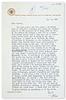 1989. A long, informative and entertaining letter, mostly about not writing, from the year prior to the publication of The Barnum Museum. He does discuss the author Joseph Skorvecky, and David Shield's Dead Languages, but he says, "In general I play ball with my three-year-old son, rake in my minuscule garden, worry about my roof, and things like that," having just "come out from under a murderous term of full-time teaching," he is "trying to remember what it is I'm supposed to be doing with my life." Millhauser would win a World Fantasy Award for his story "The Illusionist" the following year, and the Pulitzer Prize for Martin Dressler in 1997. The recipient has made several notes in the top margin; else the letter is fine.
[#036719]
SOLD
1989. A long, informative and entertaining letter, mostly about not writing, from the year prior to the publication of The Barnum Museum. He does discuss the author Joseph Skorvecky, and David Shield's Dead Languages, but he says, "In general I play ball with my three-year-old son, rake in my minuscule garden, worry about my roof, and things like that," having just "come out from under a murderous term of full-time teaching," he is "trying to remember what it is I'm supposed to be doing with my life." Millhauser would win a World Fantasy Award for his story "The Illusionist" the following year, and the Pulitzer Prize for Martin Dressler in 1997. The recipient has made several notes in the top margin; else the letter is fine.
[#036719]
SOLD
55.
MOJTABAI, A.G.
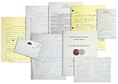 1981-1983. A file of eleven letters (9 autograph letters signed, 1 typed letter signed, and 1 autograph postcard, unsigned) written by Mojtabai to her publisher around the time of publication of her book Autumn, which won the Richard and Hinda Rosenthal Foundation Award (for a book that "while not a commercial success" was nonetheless a "considerable literary achievement") from the American Academy and Institute of Arts and Letters. In April, 1981, Mojtabai sends a new address, which is a Travelodge in Amarillo, Texas. The next letter, in July, announces she'll be forwarding a revised carbon draft of Autumn, just in case there's an accident on her return trip to NYC, "and both yours truly and the m.s. [are] demolished in transit." The third letter requests that the Maine aspect of the story not be stressed, as she is going for "universality"; she also gives specific instructions that an advance copy not fall into the hands of one particular prominent author. The fourth letter, to a copy editor, is a long, detailed, and impassioned defense of her writing style (every letter, pause, space and punctuation mark): "These are my decisions. The risks are mine. You have done all your could." The next letter, re-states her case directly to the editor (Nan Talese): "What would the copy editor do with James Joyce -- or even Mark Twain or Riddley Walker??" The next three pieces of correspondence discuss travel plans, the marketing of the book, and still more editing, including a postcard devoted entirely to an apostrophe. Before the book even hits stores, Mojtabai is writing Talese about her vision for the book that will become Blessed Assurance; she also pitches a book deal for Leroy T. Matthiesen, Bishop of Amarillo. There are two retained copies of letters from Talese to Mojtabai; the file concludes with a copy of the letter from the Academy announcing the Rosenthal Foundation Award and a program for the 1983 ceremony. A substantive group of letters by a writer who has written some 20 novels and who was viewed, at this moment in time, as "up and coming": other winners of the Rosenthal Foundation award early in their careers include Thomas Pynchon (The Crying of Lot 49), Marilynne Robinson (Housekeeping), Thomas Berger (Little Big Man), Richard Powers (Three Farmers on Their Way to a Dance), John Updike (Rabbit Run), and others who have become mainstays of American literature. The lot is fine.
[#036720]
SOLD
1981-1983. A file of eleven letters (9 autograph letters signed, 1 typed letter signed, and 1 autograph postcard, unsigned) written by Mojtabai to her publisher around the time of publication of her book Autumn, which won the Richard and Hinda Rosenthal Foundation Award (for a book that "while not a commercial success" was nonetheless a "considerable literary achievement") from the American Academy and Institute of Arts and Letters. In April, 1981, Mojtabai sends a new address, which is a Travelodge in Amarillo, Texas. The next letter, in July, announces she'll be forwarding a revised carbon draft of Autumn, just in case there's an accident on her return trip to NYC, "and both yours truly and the m.s. [are] demolished in transit." The third letter requests that the Maine aspect of the story not be stressed, as she is going for "universality"; she also gives specific instructions that an advance copy not fall into the hands of one particular prominent author. The fourth letter, to a copy editor, is a long, detailed, and impassioned defense of her writing style (every letter, pause, space and punctuation mark): "These are my decisions. The risks are mine. You have done all your could." The next letter, re-states her case directly to the editor (Nan Talese): "What would the copy editor do with James Joyce -- or even Mark Twain or Riddley Walker??" The next three pieces of correspondence discuss travel plans, the marketing of the book, and still more editing, including a postcard devoted entirely to an apostrophe. Before the book even hits stores, Mojtabai is writing Talese about her vision for the book that will become Blessed Assurance; she also pitches a book deal for Leroy T. Matthiesen, Bishop of Amarillo. There are two retained copies of letters from Talese to Mojtabai; the file concludes with a copy of the letter from the Academy announcing the Rosenthal Foundation Award and a program for the 1983 ceremony. A substantive group of letters by a writer who has written some 20 novels and who was viewed, at this moment in time, as "up and coming": other winners of the Rosenthal Foundation award early in their careers include Thomas Pynchon (The Crying of Lot 49), Marilynne Robinson (Housekeeping), Thomas Berger (Little Big Man), Richard Powers (Three Farmers on Their Way to a Dance), John Updike (Rabbit Run), and others who have become mainstays of American literature. The lot is fine.
[#036720]
SOLD
56.
MOORE, Susanna
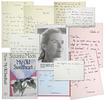 1982. Correspondence and publicity related to the publication of Moore's first book, My Old Sweetheart, which won the Prize for First Fiction from the American Academy of Arts and Letters. The file begins with an author bio and with two internal documents with information for the sales reps, including a much-hyped quote by Joan Didion that oddly did not appear on the first edition (but did appear on the Penguin paperback the following year). The file contains two autograph letters signed and five autograph notes signed by Moore, as well as several retained copies of letters and memos; several negatives and slides of author photos; a mock up for dust jacket text and a photo that were not used, and a proof copy of the jacket, without text. The correspondence from Moore transmits changes to the text; expresses gratitude for meetings or for books sent; and reports progress on her next book, here titled, first, "Bad Uncle Joe" and then, in a query, "A State of Grace," although she (correctly) adds that it sounds familiar, "perhaps it has been used before." In one interesting letter, Moore discourages any advertising done for My Old Sweetheart with the thought that the money spent would be recouped when the book is sold to the movies: "As I am of two minds about a movie sale, it would be dishonest of me to encourage him to spend money when I am hesitant about selling the book." Moore didn't sell her work to the movies until her 1995 novel In the Cut was filmed by Jane Campion in 2003, with Campion and Moore co-writing the screenplay. The lot is fine.
[#036721]
SOLD
1982. Correspondence and publicity related to the publication of Moore's first book, My Old Sweetheart, which won the Prize for First Fiction from the American Academy of Arts and Letters. The file begins with an author bio and with two internal documents with information for the sales reps, including a much-hyped quote by Joan Didion that oddly did not appear on the first edition (but did appear on the Penguin paperback the following year). The file contains two autograph letters signed and five autograph notes signed by Moore, as well as several retained copies of letters and memos; several negatives and slides of author photos; a mock up for dust jacket text and a photo that were not used, and a proof copy of the jacket, without text. The correspondence from Moore transmits changes to the text; expresses gratitude for meetings or for books sent; and reports progress on her next book, here titled, first, "Bad Uncle Joe" and then, in a query, "A State of Grace," although she (correctly) adds that it sounds familiar, "perhaps it has been used before." In one interesting letter, Moore discourages any advertising done for My Old Sweetheart with the thought that the money spent would be recouped when the book is sold to the movies: "As I am of two minds about a movie sale, it would be dishonest of me to encourage him to spend money when I am hesitant about selling the book." Moore didn't sell her work to the movies until her 1995 novel In the Cut was filmed by Jane Campion in 2003, with Campion and Moore co-writing the screenplay. The lot is fine.
[#036721]
SOLD
57.
MORRIS, Mary
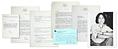 1982-1984. Correspondence and publicity related to Crossroads, Morris's second book and first novel. The file includes a completed author questionnaire; four typed letters signed; two typed notes signed; one autograph letter signed; Morris's own 4-page synopsis of the book; her C.V.; an author photo and press release; retained copies of several letters; and one typed postcard signed from Joyce Carol Oates declining, on principle, to provide commentary but adding that she has been "a supporter of Mary for some time." When the file begins, Morris is still working on the manuscript (which she submits a month later) and trying to come up with a title. Her submitted questionnaire lists filmmaking and travel among her interests: specifically, she is "working on a proposal for a film about women in the third world." She offers an impressive list of writers who may be interested in providing comment (including Oates, Ann Beattie, Anne Tyler, Margaret Atwood, Jayne Anne Phillips, Raymond Carver, E.L Doctorow, etc.). At the galley stage, Morris is reconsidering character names and musing about the need for an added scene ("--a confrontation, a blow-up. Maybe even just a little paragraph"). Three months prior to publication, she loses a debate about redesigning the dust jacket. The author photo included here differs from the one used on the book. Post-publication, Morris informs her publisher that she has been awarded the first ever prize for literature from the American Council for the Arts (and now she's off to Europe). The lot is fine. Morris has written novels and short fiction, and she has been widely praised for a series of travel memoirs.
[#036722]
SOLD
1982-1984. Correspondence and publicity related to Crossroads, Morris's second book and first novel. The file includes a completed author questionnaire; four typed letters signed; two typed notes signed; one autograph letter signed; Morris's own 4-page synopsis of the book; her C.V.; an author photo and press release; retained copies of several letters; and one typed postcard signed from Joyce Carol Oates declining, on principle, to provide commentary but adding that she has been "a supporter of Mary for some time." When the file begins, Morris is still working on the manuscript (which she submits a month later) and trying to come up with a title. Her submitted questionnaire lists filmmaking and travel among her interests: specifically, she is "working on a proposal for a film about women in the third world." She offers an impressive list of writers who may be interested in providing comment (including Oates, Ann Beattie, Anne Tyler, Margaret Atwood, Jayne Anne Phillips, Raymond Carver, E.L Doctorow, etc.). At the galley stage, Morris is reconsidering character names and musing about the need for an added scene ("--a confrontation, a blow-up. Maybe even just a little paragraph"). Three months prior to publication, she loses a debate about redesigning the dust jacket. The author photo included here differs from the one used on the book. Post-publication, Morris informs her publisher that she has been awarded the first ever prize for literature from the American Council for the Arts (and now she's off to Europe). The lot is fine. Morris has written novels and short fiction, and she has been widely praised for a series of travel memoirs.
[#036722]
SOLD
58.
NAYLOR, Gloria
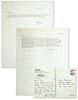 1985, 1990. Two typed notes (one signed, one unsigned) and one autograph postcard signed. The first note, unsigned, transmits her typed guest list for her 1985 book party (for the publication of Linden Hills). Naylor submits 28 names (Alice McDermott, Andrea Dworkin, Hettie Jones, Faith Sale, etc). Some RSVP notations have been added. In her note, Naylor gives instructions should deletions be needed: "I would suggest that you spare my mother and father. My sisters are expendable since I haven't known them as long and chances are they won't be as willing to support me financially when hard times hit in the coming years." The second note, signed, transmits her incidental expenses for a three city book tour. Her letter states she is owed $2412.43, when she is actually owed $132.52, but the letter is dated on April Fool's Day. Finally there is a signed postcard from 1990 granting permission to use her quote on an upcoming edition of Ann Petry's The Street. Naylor was a publishing phenomenon in the 1980s, being the first African-American female writer to write bestselling novels for a crossover audience. The lot is near fine.
[#036723]
SOLD
1985, 1990. Two typed notes (one signed, one unsigned) and one autograph postcard signed. The first note, unsigned, transmits her typed guest list for her 1985 book party (for the publication of Linden Hills). Naylor submits 28 names (Alice McDermott, Andrea Dworkin, Hettie Jones, Faith Sale, etc). Some RSVP notations have been added. In her note, Naylor gives instructions should deletions be needed: "I would suggest that you spare my mother and father. My sisters are expendable since I haven't known them as long and chances are they won't be as willing to support me financially when hard times hit in the coming years." The second note, signed, transmits her incidental expenses for a three city book tour. Her letter states she is owed $2412.43, when she is actually owed $132.52, but the letter is dated on April Fool's Day. Finally there is a signed postcard from 1990 granting permission to use her quote on an upcoming edition of Ann Petry's The Street. Naylor was a publishing phenomenon in the 1980s, being the first African-American female writer to write bestselling novels for a crossover audience. The lot is near fine.
[#036723]
SOLD
59.
OLIVER, Mary
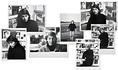 1964. Nine original 8" x 10" black and white photographs of Oliver, taken by her long-time partner, the photographer Molly Malone Cook. Includes the photograph used on the first American edition of Oliver's No Voyage and Other Poems. Each photo bears Cook's stamp on verso. Extremely early photographs, preceding her first published book, of the writer the New York Times once called "far and away [America's] bestselling poet," and they could have added "most beloved." Winner of the Pulitzer Prize in 1984 and the National Book Award in 1992. Near fine.
[#036724]
SOLD
1964. Nine original 8" x 10" black and white photographs of Oliver, taken by her long-time partner, the photographer Molly Malone Cook. Includes the photograph used on the first American edition of Oliver's No Voyage and Other Poems. Each photo bears Cook's stamp on verso. Extremely early photographs, preceding her first published book, of the writer the New York Times once called "far and away [America's] bestselling poet," and they could have added "most beloved." Winner of the Pulitzer Prize in 1984 and the National Book Award in 1992. Near fine.
[#036724]
SOLD
60.
OZICK, Cynthia
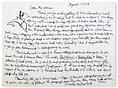 1979. A densely worded autograph postcard signed, in which Ozick agrees to let words of praise she wrote about Nina Schneider's novel (unnamed, but The Woman Who Lived in a Prologue) be used for publicity, while also championing an unpublished novel by Norma Rosen (unnamed, but At the Center, later published by Houghton Mifflin in 1982: "She is one of the most penetrating writers alive, and, amazingly, has an unpublished manuscript of great power."). On a more personal note, Ozick remarks that she was surprised to see that she had written to Schneider just two days after her own mother had entered the hospital, where she died a month later. "I don't understand how I could have found any adjectives during that time. "The prose of letters always seems inappropriate to me when seen in print -- any inadequacy is then made naked --." About 230 words. Publisher's notations on verso, else fine.
[#036725]
SOLD
1979. A densely worded autograph postcard signed, in which Ozick agrees to let words of praise she wrote about Nina Schneider's novel (unnamed, but The Woman Who Lived in a Prologue) be used for publicity, while also championing an unpublished novel by Norma Rosen (unnamed, but At the Center, later published by Houghton Mifflin in 1982: "She is one of the most penetrating writers alive, and, amazingly, has an unpublished manuscript of great power."). On a more personal note, Ozick remarks that she was surprised to see that she had written to Schneider just two days after her own mother had entered the hospital, where she died a month later. "I don't understand how I could have found any adjectives during that time. "The prose of letters always seems inappropriate to me when seen in print -- any inadequacy is then made naked --." About 230 words. Publisher's notations on verso, else fine.
[#036725]
SOLD
61.
PARKER, Robert
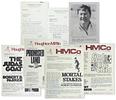 1974. Two typed notes signed with instructions regarding advance copies of The Godwulf Manuscript. Together with press releases for God Save the Child, Mortal Stakes, Promised Land, and The Judas Goat, with author photos for the latter two titles. Early correspondence by an author whose books at one point came to dominate the mystery genre, and to help it gain a credibility and respectability that it had previously lacked. The Godwulf Manuscript was Parker's first book, introducing the private eye Spenser. The long-running series spawned television shows, and it continued after Parker's death with other writers adding to Spenser's tales. Publisher's notation to one note, else fine.
[#036726]
SOLD
1974. Two typed notes signed with instructions regarding advance copies of The Godwulf Manuscript. Together with press releases for God Save the Child, Mortal Stakes, Promised Land, and The Judas Goat, with author photos for the latter two titles. Early correspondence by an author whose books at one point came to dominate the mystery genre, and to help it gain a credibility and respectability that it had previously lacked. The Godwulf Manuscript was Parker's first book, introducing the private eye Spenser. The long-running series spawned television shows, and it continued after Parker's death with other writers adding to Spenser's tales. Publisher's notation to one note, else fine.
[#036726]
SOLD
62.
PAULING, Linus
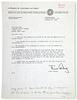 1968. Pauling, a Nobel Prize winner for Chemistry (1954) and a Nobel Peace Prize winner (1962), here declines to offer publicity praise for Sheldon Novick's The Careless Atom, owing to a "presentation by the author of an incorrect and misleading discussion of DNA." He suggests cuts to several specific galley pages. Signed by Pauling. A note in pencil across the bottom indicates that the editor has decided to leave the text as is. Near fine.
[#036727]
SOLD
1968. Pauling, a Nobel Prize winner for Chemistry (1954) and a Nobel Peace Prize winner (1962), here declines to offer publicity praise for Sheldon Novick's The Careless Atom, owing to a "presentation by the author of an incorrect and misleading discussion of DNA." He suggests cuts to several specific galley pages. Signed by Pauling. A note in pencil across the bottom indicates that the editor has decided to leave the text as is. Near fine.
[#036727]
SOLD
63.
PETERSON, Roger Tory
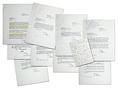 1977-1982. Twenty three pieces of correspondence (14 typed letters signed; 7 typed notes signed; plus two pieces unsigned) from Peterson to his publisher, before and after the publication of the fourth edition (1980) of A Field Guide to the Birds: A Completely New Guide to All the Birds of Eastern and Central North America, which was an update to the editions of 1934, 1939, and 1947. Peterson Field Guides were a standard reference in the 20th century, with millions of copies sold of its 50+ titles, as the brand eventually reached out well beyond birds. This file shows Peterson deep in the details of updates (tree-ducks are now whistling ducks); his competition (the Audubon guide); marketing (competitive pricing; expanding to outlets such as nature centers); layout (the endpapers, the maps, the index and the pagination); the subtitle ("all species east of the Rockies" would not be correct because "we did not include those south Texas species that get into the Rio Grande Valley where there is a strong western intrusion..."). Post-publication, the corrections continue: on page 193, the second hairy woodpecker is described as a male, but needs the words, "southern form." And in 1981: "Now is the time to remove the words completely new from the jacket...it would become ridiculous if we continued..." The later letters are concerned with royalty payments ($41,000); and future projects, such as an autobiography and perhaps a book about the development of birding in America, "showing what has happened between Audubon's time and today." Peterson's autobiography was never completed, but he does give it a title here: Free as The Birds. The file also contains two pieces of correspondence from his wife, Virginia Marie Peterson, one describing the maps that she and Roger created for the book, along with three retained copies of letters to RTP and one internal memo. Peterson -- a birder and an artist to begin with -- became a virtual institution over the years and a major figure in the environmental and conservation movements. He was awarded the Presidential Medal of Freedom -- the nation's highest civilian honor -- and his art was exhibited at the Smithsonian Institution, among other places. The lot is fine.
[#036728]
SOLD
1977-1982. Twenty three pieces of correspondence (14 typed letters signed; 7 typed notes signed; plus two pieces unsigned) from Peterson to his publisher, before and after the publication of the fourth edition (1980) of A Field Guide to the Birds: A Completely New Guide to All the Birds of Eastern and Central North America, which was an update to the editions of 1934, 1939, and 1947. Peterson Field Guides were a standard reference in the 20th century, with millions of copies sold of its 50+ titles, as the brand eventually reached out well beyond birds. This file shows Peterson deep in the details of updates (tree-ducks are now whistling ducks); his competition (the Audubon guide); marketing (competitive pricing; expanding to outlets such as nature centers); layout (the endpapers, the maps, the index and the pagination); the subtitle ("all species east of the Rockies" would not be correct because "we did not include those south Texas species that get into the Rio Grande Valley where there is a strong western intrusion..."). Post-publication, the corrections continue: on page 193, the second hairy woodpecker is described as a male, but needs the words, "southern form." And in 1981: "Now is the time to remove the words completely new from the jacket...it would become ridiculous if we continued..." The later letters are concerned with royalty payments ($41,000); and future projects, such as an autobiography and perhaps a book about the development of birding in America, "showing what has happened between Audubon's time and today." Peterson's autobiography was never completed, but he does give it a title here: Free as The Birds. The file also contains two pieces of correspondence from his wife, Virginia Marie Peterson, one describing the maps that she and Roger created for the book, along with three retained copies of letters to RTP and one internal memo. Peterson -- a birder and an artist to begin with -- became a virtual institution over the years and a major figure in the environmental and conservation movements. He was awarded the Presidential Medal of Freedom -- the nation's highest civilian honor -- and his art was exhibited at the Smithsonian Institution, among other places. The lot is fine.
[#036728]
SOLD
64.
PETRY, Ann
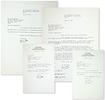 1990-1992. One typed letter signed and four typed notes signed, all regarding the 1992 paperback reissue of her 1946 novel, The Street (initially slated for 1991). In the initial letter, Petry declines, at length, to write an introduction to the new edition, calling introductions to contemporary novels "condescending" and an "unforgivable intrusion." She denies that her novel (published 45 years prior) needs historical context "unless, of course, the reader has been living on another planet...." (The edition was issued without introduction.) A follow-up note returns the author questionnaire (not present); the final three notes all express an appreciation for being sent advance copies or actual copies of the new edition, as well as her delight in how the edition turned out. The letters are folded for mailing; else fine. The Street won the Houghton Mifflin Literary Fellowship Award when first published in 1946, the first time the prize was given to an African American woman.
[#036729]
SOLD
1990-1992. One typed letter signed and four typed notes signed, all regarding the 1992 paperback reissue of her 1946 novel, The Street (initially slated for 1991). In the initial letter, Petry declines, at length, to write an introduction to the new edition, calling introductions to contemporary novels "condescending" and an "unforgivable intrusion." She denies that her novel (published 45 years prior) needs historical context "unless, of course, the reader has been living on another planet...." (The edition was issued without introduction.) A follow-up note returns the author questionnaire (not present); the final three notes all express an appreciation for being sent advance copies or actual copies of the new edition, as well as her delight in how the edition turned out. The letters are folded for mailing; else fine. The Street won the Houghton Mifflin Literary Fellowship Award when first published in 1946, the first time the prize was given to an African American woman.
[#036729]
SOLD
65.
SCHAEFER, Jack
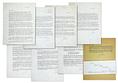 1971-1977. Forty-one typed letters signed by Schaefer, author of the classic Western novel Shane: these letters date from the period in his life when he was receiving the Western Literature Association's Distinguished Achievement Award and yet pivoting to recast himself as a naturalist and conservationist, most notably with his book An American Bestiary. The archive begins with a brief 1967 publisher's bio of Schaefer, but the correspondence begins in 1971, when the Bestiary was still a "New Mexico Bestiary," and Schaefer had produced essays only on the pronghorn, the opossum, the shrew, and the armadillo. Shortly thereafter there is a request from Marvel Comics to produce a comic based on Shane (declined), and talk of a film version of Schaefer's children's book Stubby Pringle's Christmas (which did eventually happen). The Bestiary discussions continue with debates about form, tone, content, title, illustrations, and Schaefer's advance, throughout which Schaefer exudes enthusiasm for his lagomorphs and leporids, etc. (though he admits he "made a mistake tackling the Bats as a bunch"). In 1974, he submits a 410 page manuscript (not included), which only serves to increase the discussions about form, tone, content (regionalism), title (Beauty in the Beasts?), illustrations, etc. and now adds discussions of pronouns (the animals can't all be male). There are several pages of Schaefer defending both his vision for the book and his style choices. Biologist James Findley is brought on to vet the manuscript and write an introduction; Linda K. Powell is recruited as illustrator. During the production process, Schaefer begins "interviewing" his animals, drafting what would become Conversations with a Pocket Gopher. Schaefer's letters tend to be long and chatty, frequently with news of his writing and non-writing projects, his reading, his wife, his yard and his neighborhood. By 1977 there is also some discussion about why Bestiary did not live up to expectations: "At the very time I was getting increased critical attention to my previous work, I jumped into something completely different...The Bestiary was released in the same month during which papers about my previous work were presented at the Western Literature Association convention and Distinguished Achievement Award being given me." In addition to Schaefer's letters, the archive contains approximately 100 copies of retained letters and memos for context, in addition to several examples of printed matter related to the published book: the style sheet and manufacturing record; typescript of prelims and jacket copy; a publisher's bio of Schaefer, etc. Apart from publisher's markings on various pages; the lot is fine.
[#036730]
SOLD
1971-1977. Forty-one typed letters signed by Schaefer, author of the classic Western novel Shane: these letters date from the period in his life when he was receiving the Western Literature Association's Distinguished Achievement Award and yet pivoting to recast himself as a naturalist and conservationist, most notably with his book An American Bestiary. The archive begins with a brief 1967 publisher's bio of Schaefer, but the correspondence begins in 1971, when the Bestiary was still a "New Mexico Bestiary," and Schaefer had produced essays only on the pronghorn, the opossum, the shrew, and the armadillo. Shortly thereafter there is a request from Marvel Comics to produce a comic based on Shane (declined), and talk of a film version of Schaefer's children's book Stubby Pringle's Christmas (which did eventually happen). The Bestiary discussions continue with debates about form, tone, content, title, illustrations, and Schaefer's advance, throughout which Schaefer exudes enthusiasm for his lagomorphs and leporids, etc. (though he admits he "made a mistake tackling the Bats as a bunch"). In 1974, he submits a 410 page manuscript (not included), which only serves to increase the discussions about form, tone, content (regionalism), title (Beauty in the Beasts?), illustrations, etc. and now adds discussions of pronouns (the animals can't all be male). There are several pages of Schaefer defending both his vision for the book and his style choices. Biologist James Findley is brought on to vet the manuscript and write an introduction; Linda K. Powell is recruited as illustrator. During the production process, Schaefer begins "interviewing" his animals, drafting what would become Conversations with a Pocket Gopher. Schaefer's letters tend to be long and chatty, frequently with news of his writing and non-writing projects, his reading, his wife, his yard and his neighborhood. By 1977 there is also some discussion about why Bestiary did not live up to expectations: "At the very time I was getting increased critical attention to my previous work, I jumped into something completely different...The Bestiary was released in the same month during which papers about my previous work were presented at the Western Literature Association convention and Distinguished Achievement Award being given me." In addition to Schaefer's letters, the archive contains approximately 100 copies of retained letters and memos for context, in addition to several examples of printed matter related to the published book: the style sheet and manufacturing record; typescript of prelims and jacket copy; a publisher's bio of Schaefer, etc. Apart from publisher's markings on various pages; the lot is fine.
[#036730]
SOLD
66.
(SHEEHAN, Susan), STAFFORD, Jean, et al
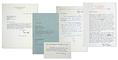 1976. Letters by Jean Stafford, Dame Rebecca West, Doris Grumbach, and Douglas Brinkley, all written in support of Sheehan's 1976 book A Welfare Mother, which first appeared as an article in The New Yorker. Rebecca West, in a typed letter signed says she is "enchanted" by it, and then explains her word choice before calling the book "important work." The autograph postcard signed from David Brinkley calls the work honest and informative. In an autograph letter signed by Doris Grumbach, Grumbach suggests doing a piece on the book for The Washingtonian. Jean Stafford provides two typed letters signed, the first of which transmits galleys of her unpublished review of the book for Esquire (included here), along with her scathing commentary on Esquire (as well as the Hamptons in Long Island). A follow-up typed letter signed from Stafford mostly chronicles her considerable health issues. Five letters total (note that none are from Sheehan herself), with six retained letters to the named writers, and the unpublished Stafford review. The lot is fine. Sheehan has received high praise for her nonfiction writings, including from Alfred Knopf, who published her book Ten Vietnamese in the 1960s. Her husband, Neil Sheehan, was also a writer: his Vietnam book, A Bright Shining Lie, won the Pulitzer Prize and the National Book Award.
[#036731]
SOLD
1976. Letters by Jean Stafford, Dame Rebecca West, Doris Grumbach, and Douglas Brinkley, all written in support of Sheehan's 1976 book A Welfare Mother, which first appeared as an article in The New Yorker. Rebecca West, in a typed letter signed says she is "enchanted" by it, and then explains her word choice before calling the book "important work." The autograph postcard signed from David Brinkley calls the work honest and informative. In an autograph letter signed by Doris Grumbach, Grumbach suggests doing a piece on the book for The Washingtonian. Jean Stafford provides two typed letters signed, the first of which transmits galleys of her unpublished review of the book for Esquire (included here), along with her scathing commentary on Esquire (as well as the Hamptons in Long Island). A follow-up typed letter signed from Stafford mostly chronicles her considerable health issues. Five letters total (note that none are from Sheehan herself), with six retained letters to the named writers, and the unpublished Stafford review. The lot is fine. Sheehan has received high praise for her nonfiction writings, including from Alfred Knopf, who published her book Ten Vietnamese in the 1960s. Her husband, Neil Sheehan, was also a writer: his Vietnam book, A Bright Shining Lie, won the Pulitzer Prize and the National Book Award.
[#036731]
SOLD
67.
SPOCK, Benjamin
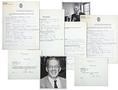 1961-1964. A small archive from the years during which the author published Dr. Spock Talks with Mothers and Problems of Parents. Includes two typed notes signed, two author bios (one filled in by hand and one mimeographed), and a 7-page author questionnaire (from 1961), on which Dr. Spock has answered questions in holograph about schools he attended; places he's lived; hobbies (sailing, with details on where and when); writing habits (where, when, how much); how he began writing ("My mother demanded of all her children detailed descriptions of every hour when away from home, characterizing people met"); favorite writers; how he got the idea for the book (asked to write a column for Ladies Home Journal "just when I had a special need for more money"); any special research needed ("Almost all of it out of my head - or on experiences talking with parents"); his ideas for marketing the book; willingness to travel; etc. The above is accompanied by five publicity photos of Spock and two of his wife "receiving congratulations on behalf of her husband" at a conference where Problems of Parents won the Child Study Associations Family Life Book Award. One of the typed notes has a large red checkmark across it; the lot is near fine.
[#036732]
SOLD
1961-1964. A small archive from the years during which the author published Dr. Spock Talks with Mothers and Problems of Parents. Includes two typed notes signed, two author bios (one filled in by hand and one mimeographed), and a 7-page author questionnaire (from 1961), on which Dr. Spock has answered questions in holograph about schools he attended; places he's lived; hobbies (sailing, with details on where and when); writing habits (where, when, how much); how he began writing ("My mother demanded of all her children detailed descriptions of every hour when away from home, characterizing people met"); favorite writers; how he got the idea for the book (asked to write a column for Ladies Home Journal "just when I had a special need for more money"); any special research needed ("Almost all of it out of my head - or on experiences talking with parents"); his ideas for marketing the book; willingness to travel; etc. The above is accompanied by five publicity photos of Spock and two of his wife "receiving congratulations on behalf of her husband" at a conference where Problems of Parents won the Child Study Associations Family Life Book Award. One of the typed notes has a large red checkmark across it; the lot is near fine.
[#036732]
SOLD
68.
STEGNER, Wallace
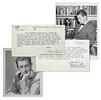 1960, 1970. Two typed postcards signed by Stegner, both written to the Houghton Mifflin publicity department. In the first, from 1960, he says he cannot read the David Walker and Richard Dohrman books because of having to read student manuscripts, "plus the DeVoto shenanigans this weekend, plus the Esquire shenanigans a couple of weeks later..." Signed, "Wally Stegner." In the second postcard, from 1970, Stegner writes from Vermont that he won't be able to read Tom Mayer's book [likely The Weary Falcon], which they've mailed to Stanford. Signed, "Wallace Stegner." In addition, four different Stegner publicity photos, apparently from the 1940s to 60s, are included. The lot is near fine. Stegner was long considered the "dean" of Western American writers, and he had a longterm writing workshop at Stanford University that graduated such writers as Larry McMurtry, Tillie Olsen, Ken Kesey, Wendell Berry and Robert Stone.
[#036733]
SOLD
1960, 1970. Two typed postcards signed by Stegner, both written to the Houghton Mifflin publicity department. In the first, from 1960, he says he cannot read the David Walker and Richard Dohrman books because of having to read student manuscripts, "plus the DeVoto shenanigans this weekend, plus the Esquire shenanigans a couple of weeks later..." Signed, "Wally Stegner." In the second postcard, from 1970, Stegner writes from Vermont that he won't be able to read Tom Mayer's book [likely The Weary Falcon], which they've mailed to Stanford. Signed, "Wallace Stegner." In addition, four different Stegner publicity photos, apparently from the 1940s to 60s, are included. The lot is near fine. Stegner was long considered the "dean" of Western American writers, and he had a longterm writing workshop at Stanford University that graduated such writers as Larry McMurtry, Tillie Olsen, Ken Kesey, Wendell Berry and Robert Stone.
[#036733]
SOLD
69.
STONE, Robert
 1967-1975. The publisher's archive for Robert Stone's National Book Award-winning second novel, Dog Soldiers, which was published in 1974, seven years after his first novel, A Hall of Mirrors, won the 1967 Houghton Mifflin Literary Fellowship Award. This file begins in 1967 with Stone's 3-page outline of his second novel, here titled "The Dog Soldier." A typed letter signed from 1969 offers a progress update, stating that he hopes to have the manuscript completed in 1970, and he writes of his intervening work on a screenplay [for WUSA, the film based on a A Hall of Mirrors]. The next typed letter signed has Stone explaining why the IRS has contacted Houghton Mifflin with a lien against any funds due him, explaining that he has been withholding 25% of his taxes as "a small and conceivably futile gesture" to protest "our country's present overseas adventure" [in Vietnam]. A series of five typed notes signed from 1974 transmit a change of address, text corrections (not present), and delve into his use of the word "esthos." A letter transmits Stone's typewritten author bio, a short but revealing paragraph that includes Stone's having "participated in some of the events that led to the development of what has been called the Counter-Culture" -- meaning the Stanford writers' LSD parties at Ken Kesey's house, which predated the legendary cross-country bus trip that Kesey took with the Merry Pranksters in 1964; HMCo edited that out of the final copy calling the claim too "arch" and "ornate," thus helping to obscure the origins of that movement for several decades. The archive contains approximately 60 retained letters and internal memos covering the book's publication and publicity. Several of these indicate that advance galleys were sent to Ken Kesey, Tom Wolfe, David Halberstam and Frances Fitzgerald, among others. Kesey's response is recorded here: "Dog Soldiers has raised paranoia to new artistic heights." There are several press releases, as well as drafts and mock-ups of press releases, and a cache of about 20 published reviews of the book. There is also a publicity photo for A Hall of Mirrors, signed by Stone (with one of the earlier scheduled publication dates on it). The file ends with a copy of the typescript of Stone's National Book Award acceptance speech, prepared in advance and delivered in April 1975, as well as the correspondence around that speech: had he not won the award, no one would have seen it. A unique and extensive file of an award-winning novel by one of the major American writers of his era. The lot is fine.
[#036734]
SOLD
1967-1975. The publisher's archive for Robert Stone's National Book Award-winning second novel, Dog Soldiers, which was published in 1974, seven years after his first novel, A Hall of Mirrors, won the 1967 Houghton Mifflin Literary Fellowship Award. This file begins in 1967 with Stone's 3-page outline of his second novel, here titled "The Dog Soldier." A typed letter signed from 1969 offers a progress update, stating that he hopes to have the manuscript completed in 1970, and he writes of his intervening work on a screenplay [for WUSA, the film based on a A Hall of Mirrors]. The next typed letter signed has Stone explaining why the IRS has contacted Houghton Mifflin with a lien against any funds due him, explaining that he has been withholding 25% of his taxes as "a small and conceivably futile gesture" to protest "our country's present overseas adventure" [in Vietnam]. A series of five typed notes signed from 1974 transmit a change of address, text corrections (not present), and delve into his use of the word "esthos." A letter transmits Stone's typewritten author bio, a short but revealing paragraph that includes Stone's having "participated in some of the events that led to the development of what has been called the Counter-Culture" -- meaning the Stanford writers' LSD parties at Ken Kesey's house, which predated the legendary cross-country bus trip that Kesey took with the Merry Pranksters in 1964; HMCo edited that out of the final copy calling the claim too "arch" and "ornate," thus helping to obscure the origins of that movement for several decades. The archive contains approximately 60 retained letters and internal memos covering the book's publication and publicity. Several of these indicate that advance galleys were sent to Ken Kesey, Tom Wolfe, David Halberstam and Frances Fitzgerald, among others. Kesey's response is recorded here: "Dog Soldiers has raised paranoia to new artistic heights." There are several press releases, as well as drafts and mock-ups of press releases, and a cache of about 20 published reviews of the book. There is also a publicity photo for A Hall of Mirrors, signed by Stone (with one of the earlier scheduled publication dates on it). The file ends with a copy of the typescript of Stone's National Book Award acceptance speech, prepared in advance and delivered in April 1975, as well as the correspondence around that speech: had he not won the award, no one would have seen it. A unique and extensive file of an award-winning novel by one of the major American writers of his era. The lot is fine.
[#036734]
SOLD
70.
TAYLOR, Peter
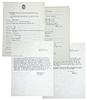 1972-1973. The file begins with an in-house recommendation that Houghton Mifflin publish Taylor, as he has become "disenchanted" with Farrar, Straus, and Giroux, and follows with a page stating the terms of his pending contract. Taylor's direct contributions here include two typed letters signed; an undated preliminary author questionnaire (typed); and a later, longer (8 page) questionnaire, signed by the author and completed by hand. In the first letter, Taylor reacts with pleasure to the paucity of corrections needed in the proofs, and muses about his own proclivities with parentheses. The second letter transmits the longer author questionnaire as well as a press release from the University of Virginia that covers questions that he chose not to answer, while also directing that photos of him previously taken by Jill Krementz be used for the jacket. The questionnaire itself covers biographical information; teaching positions held; previous publications; towns and media outlets to which Taylor has a connection; and salient points about the book for advertising purposes. Here, he writes (in part): "I am a writer who has always regarded the short story as a dramatic form, closer to the play than to the novel..." Approximately a dozen other copies of letters and memos round out the file, including Krementz's invoice; copies of or transcriptions of blurbs by James Dickey and William Alfred; several pages with marketing information such as the initial print run and the list of authors receiving complimentary copies (a list that includes Joyce Carol Oates, Elizabeth Hardwick, Allen Tate, Lillian Hellman, Robert Penn Warren, etc.). Taylor won the Pulitzer Prize for his novel A Summons to Memphis and the PEN/Faulkner Award for his story collection, The Old Forest and Other Stories. The Library of America issued a two-volume collection of his complete short stories. The lot is near fine.
[#036735]
SOLD
1972-1973. The file begins with an in-house recommendation that Houghton Mifflin publish Taylor, as he has become "disenchanted" with Farrar, Straus, and Giroux, and follows with a page stating the terms of his pending contract. Taylor's direct contributions here include two typed letters signed; an undated preliminary author questionnaire (typed); and a later, longer (8 page) questionnaire, signed by the author and completed by hand. In the first letter, Taylor reacts with pleasure to the paucity of corrections needed in the proofs, and muses about his own proclivities with parentheses. The second letter transmits the longer author questionnaire as well as a press release from the University of Virginia that covers questions that he chose not to answer, while also directing that photos of him previously taken by Jill Krementz be used for the jacket. The questionnaire itself covers biographical information; teaching positions held; previous publications; towns and media outlets to which Taylor has a connection; and salient points about the book for advertising purposes. Here, he writes (in part): "I am a writer who has always regarded the short story as a dramatic form, closer to the play than to the novel..." Approximately a dozen other copies of letters and memos round out the file, including Krementz's invoice; copies of or transcriptions of blurbs by James Dickey and William Alfred; several pages with marketing information such as the initial print run and the list of authors receiving complimentary copies (a list that includes Joyce Carol Oates, Elizabeth Hardwick, Allen Tate, Lillian Hellman, Robert Penn Warren, etc.). Taylor won the Pulitzer Prize for his novel A Summons to Memphis and the PEN/Faulkner Award for his story collection, The Old Forest and Other Stories. The Library of America issued a two-volume collection of his complete short stories. The lot is near fine.
[#036735]
SOLD
71.
THEROUX, Paul
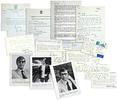 1966-1980. Ten pieces of correspondence (eight signed postcards -- four autograph and four typed; one typed note signed; and one autograph letter signed), along with a two-page signed biographical statement. In the first letter, from Uganda, in 1966, Theroux says he has completed the questionnaire and is working on author photos. The questionnaire is not included but a requested "formal biography" is here; in it Theroux describes his family ("quite close and intellectual to the point of being nearly rabid with omniscience"); his state of "restless intellectual scratching" in college; his arrest for organizing a picket; his move to Africa and his early successes as a poet; his writing of Waldo and also Murder in Mount Holly. He references the Roman poet Horace regarding speaking the truth with a smile and adds, "I am as concerned with humor as I am with the scream that is in each burst of laughter." The postcards and one letter that follow are mostly from the 1970s: the first postcard notes his move to England; the next transmits the novel Saint Jack; a third corrects the book's jacket copy. The letter transmits a review of Saint Jack, asks for a copy to be sent to Peter DeVries, and mentions he'll be leaving on a fishing trip with Robert Lowell. The later postcards speak of more reviews, photos taken by Jill Krementz, and an improving tennis game, and Theroux is just starting to mention traveling to China. Five publicity photos are included (1969-1978), and one retained internal memo requests that three of Theroux's novels be sent to Robert Stone. The first, airmail letter, is missing the corner where the stamps once were; there are several publisher's notations to the lot, which, overall, is near fine.
[#036736]
SOLD
1966-1980. Ten pieces of correspondence (eight signed postcards -- four autograph and four typed; one typed note signed; and one autograph letter signed), along with a two-page signed biographical statement. In the first letter, from Uganda, in 1966, Theroux says he has completed the questionnaire and is working on author photos. The questionnaire is not included but a requested "formal biography" is here; in it Theroux describes his family ("quite close and intellectual to the point of being nearly rabid with omniscience"); his state of "restless intellectual scratching" in college; his arrest for organizing a picket; his move to Africa and his early successes as a poet; his writing of Waldo and also Murder in Mount Holly. He references the Roman poet Horace regarding speaking the truth with a smile and adds, "I am as concerned with humor as I am with the scream that is in each burst of laughter." The postcards and one letter that follow are mostly from the 1970s: the first postcard notes his move to England; the next transmits the novel Saint Jack; a third corrects the book's jacket copy. The letter transmits a review of Saint Jack, asks for a copy to be sent to Peter DeVries, and mentions he'll be leaving on a fishing trip with Robert Lowell. The later postcards speak of more reviews, photos taken by Jill Krementz, and an improving tennis game, and Theroux is just starting to mention traveling to China. Five publicity photos are included (1969-1978), and one retained internal memo requests that three of Theroux's novels be sent to Robert Stone. The first, airmail letter, is missing the corner where the stamps once were; there are several publisher's notations to the lot, which, overall, is near fine.
[#036736]
SOLD
72.
TOLKIEN, J.R.R.
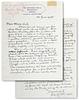 1955. Tolkien writes in his near-calligraphic script to Anne Ford of Houghton Mifflin, defending himself to his publishers from a piece written by Harvey Breit in the New York Times Book Review, while also saying he is pleased to be the subject of a talk by Gilbert Highet, "or rather (as I hope) my book: I hope indeed he will concern himself mainly with The Lord of The Rings, and as little as possible with me. The relation between the two is (naturally) far too complex for a few 'facts' to elucidate... ....This is not either ill temper (I am of quite a kindly disposition) or modesty (I am quite prepared to talk about myself at length, when I have time). But I have just emerged from a very grueling time of unremitting labours, and long for some rest and sleep --- but I have all the final proofs of Vol. III upon me." He then says he will, out of sheer pity and amusement, enclose a few notes (not included here), and ends by requesting the use of an alternate mailing address in the future. Signed, "Yours sincerely/ J.R.R. Tolkien." This corresponds to letter #165 from Humphrey Carpenter's Letters of J.R.R. Tolkien (Houghton Mifflin, 1981). Nearly 300 words; written on both sides of the page. 5-3/16" x 6-3/4". Publisher's notation in upper margin, where there is also a small piece of edge tape. Near fine. Tolkien's letters written prior to the completion of The Lord of the Rings are both scarcer than his later letters and often more interesting, in that they deal with his actual work and himself as a working writer, rather than as a celebrity and cult figure as he later came to be, at least to much of his audience. This letter, written to his publisher after he had finished The Return of the King but prior to having completed the revisions of its proofs, shows him as a busy, working writer, with no real hint yet of the impact his work will have, and appreciating that a well-known literary personage -- Highet -- will be devoting time and energy to the work that had dominated Tolkien's life at this point for the better part of a decade.
[#036662]
SOLD
1955. Tolkien writes in his near-calligraphic script to Anne Ford of Houghton Mifflin, defending himself to his publishers from a piece written by Harvey Breit in the New York Times Book Review, while also saying he is pleased to be the subject of a talk by Gilbert Highet, "or rather (as I hope) my book: I hope indeed he will concern himself mainly with The Lord of The Rings, and as little as possible with me. The relation between the two is (naturally) far too complex for a few 'facts' to elucidate... ....This is not either ill temper (I am of quite a kindly disposition) or modesty (I am quite prepared to talk about myself at length, when I have time). But I have just emerged from a very grueling time of unremitting labours, and long for some rest and sleep --- but I have all the final proofs of Vol. III upon me." He then says he will, out of sheer pity and amusement, enclose a few notes (not included here), and ends by requesting the use of an alternate mailing address in the future. Signed, "Yours sincerely/ J.R.R. Tolkien." This corresponds to letter #165 from Humphrey Carpenter's Letters of J.R.R. Tolkien (Houghton Mifflin, 1981). Nearly 300 words; written on both sides of the page. 5-3/16" x 6-3/4". Publisher's notation in upper margin, where there is also a small piece of edge tape. Near fine. Tolkien's letters written prior to the completion of The Lord of the Rings are both scarcer than his later letters and often more interesting, in that they deal with his actual work and himself as a working writer, rather than as a celebrity and cult figure as he later came to be, at least to much of his audience. This letter, written to his publisher after he had finished The Return of the King but prior to having completed the revisions of its proofs, shows him as a busy, working writer, with no real hint yet of the impact his work will have, and appreciating that a well-known literary personage -- Highet -- will be devoting time and energy to the work that had dominated Tolkien's life at this point for the better part of a decade.
[#036662]
SOLD
73.
TOLKIEN, J.R.R. and AUDEN, W.H.
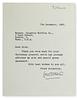 1966. A typed note signed by Tolkien, written to his publishers at Houghton Mifflin, thanking them for a Christmas present, "which has already afforded my wife and myself great amusement." Signed, "J.R.R. Tolkien." 5 3/8" x 7". Publisher's notations in the top margin and on verso; fine. Together with a signed postcard to Houghton Mifflin from W.H. Auden, also from 1966, thanking them for sending the revised edition of Tolkien's The Lord of The Rings and informing them that there is still a discrepancy in Samwise's (here written as "Sam Hamwise's" [?]) birthday across Appendix B and the Family Tree. Someone has clarified Auden's handwriting in pencil, making "birthday" legible. The known (and much debated on the internet) discrepancy is actually in the birth year rather than the birthday; the card is fine. The pairing of communications has an interesting backstory: Auden was reportedly a big fan of Tolkien's Lord of the Rings and in 1966 had agreed to do a book called J.R.R. Tolkien in Christian Perspective for a religious publisher, Eerdman's. Tolkien, when he heard of it, was incensed, calling it a "premature impertinence" and advising the publisher that he would have no part in such a thing, that he and Auden had no significant relationship, and that a talk Auden had given to the Tolkien Society "showed him to be entirely mistaken about my views on the topics he touched on." Needless to say, the proposed book never happened; Tolkien was desperately trying to finish writing The Silmarillion, something he was unable to do before he died in 1973; it was published posthumously in 1977. A glimpse at an unusual case of literary fandom: it has been said that Auden's enthusiasm for Tolkien's writing helped give it credibility and a respectability early on that it might not otherwise have had, but Tolkien -- fandom notwithstanding -- saw Auden as having missed the point entirely and, equally, having overstepped his bounds.
[#036737]
SOLD
1966. A typed note signed by Tolkien, written to his publishers at Houghton Mifflin, thanking them for a Christmas present, "which has already afforded my wife and myself great amusement." Signed, "J.R.R. Tolkien." 5 3/8" x 7". Publisher's notations in the top margin and on verso; fine. Together with a signed postcard to Houghton Mifflin from W.H. Auden, also from 1966, thanking them for sending the revised edition of Tolkien's The Lord of The Rings and informing them that there is still a discrepancy in Samwise's (here written as "Sam Hamwise's" [?]) birthday across Appendix B and the Family Tree. Someone has clarified Auden's handwriting in pencil, making "birthday" legible. The known (and much debated on the internet) discrepancy is actually in the birth year rather than the birthday; the card is fine. The pairing of communications has an interesting backstory: Auden was reportedly a big fan of Tolkien's Lord of the Rings and in 1966 had agreed to do a book called J.R.R. Tolkien in Christian Perspective for a religious publisher, Eerdman's. Tolkien, when he heard of it, was incensed, calling it a "premature impertinence" and advising the publisher that he would have no part in such a thing, that he and Auden had no significant relationship, and that a talk Auden had given to the Tolkien Society "showed him to be entirely mistaken about my views on the topics he touched on." Needless to say, the proposed book never happened; Tolkien was desperately trying to finish writing The Silmarillion, something he was unable to do before he died in 1973; it was published posthumously in 1977. A glimpse at an unusual case of literary fandom: it has been said that Auden's enthusiasm for Tolkien's writing helped give it credibility and a respectability early on that it might not otherwise have had, but Tolkien -- fandom notwithstanding -- saw Auden as having missed the point entirely and, equally, having overstepped his bounds.
[#036737]
SOLD
74.
TOWNSHEND, Pete
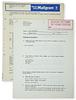 1985. An 11-page photocopied author questionnaire filled out by Townshend prior to the 1985 U.S. release of Horse's Neck, his collection of "autobiographical impressions." Previous positions: "Leader of The Who." Current positions: "...consultant editor to Faber and Faber" (who published the U.K. edition of Horse's Neck). Hobbies: "Sailing. Indian Mysticism and Sufism," and also not riding horses, and "the book uses this fact as a central theme." Townshend is very forthcoming about how he came to write the book, his thoughts on other books about him/The Who on the market, and what he attempted to accomplish in writing the book, which "focuses mainly on my obsession with physical beauty and success and my belief that as a young child I came close to being rejected by my mother because she did not find me beautiful enough." His intended audience: "WHO fans. English literature students. Rock musicologists. Anyone from the so-called 'Woodstock Generation.' Anyone who is interested in Jungian psychology." As for promotional ideas, he adds, that "As far as I know, my book is the first 'real' book ever written by a rock star. It isn't a diary, it isn't a biography....It feels to me as though I have written an impossible song for the first time." The response in the section about supplying a photo has been whited out; there is a publisher's sticky note attached that reads in part, "Author very promotable." Note that Townshend's responses have been typed, and the questionnaire is not signed. Included is a transcription of the questionnaire on Western Union Mailgram paper. Near fine.
[#036738]
SOLD
1985. An 11-page photocopied author questionnaire filled out by Townshend prior to the 1985 U.S. release of Horse's Neck, his collection of "autobiographical impressions." Previous positions: "Leader of The Who." Current positions: "...consultant editor to Faber and Faber" (who published the U.K. edition of Horse's Neck). Hobbies: "Sailing. Indian Mysticism and Sufism," and also not riding horses, and "the book uses this fact as a central theme." Townshend is very forthcoming about how he came to write the book, his thoughts on other books about him/The Who on the market, and what he attempted to accomplish in writing the book, which "focuses mainly on my obsession with physical beauty and success and my belief that as a young child I came close to being rejected by my mother because she did not find me beautiful enough." His intended audience: "WHO fans. English literature students. Rock musicologists. Anyone from the so-called 'Woodstock Generation.' Anyone who is interested in Jungian psychology." As for promotional ideas, he adds, that "As far as I know, my book is the first 'real' book ever written by a rock star. It isn't a diary, it isn't a biography....It feels to me as though I have written an impossible song for the first time." The response in the section about supplying a photo has been whited out; there is a publisher's sticky note attached that reads in part, "Author very promotable." Note that Townshend's responses have been typed, and the questionnaire is not signed. Included is a transcription of the questionnaire on Western Union Mailgram paper. Near fine.
[#036738]
SOLD
75.
UNSWORTH, Barry
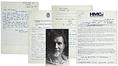 1973. A small archive from the time of publication of his novel Mooncranker's Gift, consisting of a full-page typed author bio, an 8-page author questionnaire, an autograph letter signed, and a press release edited in Unsworth's hand. The archive begins with the letter, which transmits the questionnaire along with author photos (not present) that had been taken by Fay Godwin. Unsworth's biographical statement recounts the trajectory of his life, from being born the son of a coal miner/insurance agent, to university and then to the army, and then to a series of odd jobs before beginning his attempts at becoming a writer. He supplies long hand-written answers to many of the questions on the author questionnaire, including influences (Eudora Welty, Carson McCullers, D.H. Lawrence); the origins for the idea for the book; his writing methods; and his difficulties encountered in the writing. He makes three changes to the official press release. There are also two copies of retained letters and the receipt of a payment to Fay Godwin, as well as two author photos, which are apparently from a later date and not by Godwin. Unsworth would win the Booker Prize for Sacred Hunger in 1992. The lot is fine.
[#036739]
SOLD
1973. A small archive from the time of publication of his novel Mooncranker's Gift, consisting of a full-page typed author bio, an 8-page author questionnaire, an autograph letter signed, and a press release edited in Unsworth's hand. The archive begins with the letter, which transmits the questionnaire along with author photos (not present) that had been taken by Fay Godwin. Unsworth's biographical statement recounts the trajectory of his life, from being born the son of a coal miner/insurance agent, to university and then to the army, and then to a series of odd jobs before beginning his attempts at becoming a writer. He supplies long hand-written answers to many of the questions on the author questionnaire, including influences (Eudora Welty, Carson McCullers, D.H. Lawrence); the origins for the idea for the book; his writing methods; and his difficulties encountered in the writing. He makes three changes to the official press release. There are also two copies of retained letters and the receipt of a payment to Fay Godwin, as well as two author photos, which are apparently from a later date and not by Godwin. Unsworth would win the Booker Prize for Sacred Hunger in 1992. The lot is fine.
[#036739]
SOLD
76.
UPDIKE, John
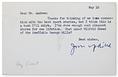 1991. Updike declines what appears to be an offer to edit The Best American Sports Writing 1991. "I've done enough such pleasant chores for a lifetime." He suggests Wilfrid Sheed or George Wills. Although the name Roy Blount is written in pencil on the postcard, the task eventually fell to David Halberstam. Signed by Updike. Fine.
[#036740]
SOLD
1991. Updike declines what appears to be an offer to edit The Best American Sports Writing 1991. "I've done enough such pleasant chores for a lifetime." He suggests Wilfrid Sheed or George Wills. Although the name Roy Blount is written in pencil on the postcard, the task eventually fell to David Halberstam. Signed by Updike. Fine.
[#036740]
SOLD
77.
VIERTEL, Peter
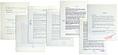 1983-1985. An archive of seven typed letters signed and an author questionnaire from the time of publication of Viertel's novel American Skin. However, the archive begins with a typed letter signed by Irwin Shaw, with whom Viertel had co-written the 1948 play Survivors. Shaw submits a paragraph of praise for Viertel's new book, saying, in part, that he "has written with wisdom, grace and passion about the nature of love and sin." Next, in the 11-page author questionnaire, Viertel gives terse answers about his hobbies, and the origin and theme of the novel, etc., but he does supply a list of about a dozen names of people (Isherwood, Vidal, Styron, Dunne, Kanin, Kajan, Welles, etc.) who might respond positively to being sent galleys. (Shaw is not on his list.) Viertel's first letter here takes polite issue with the dust jacket art. The second letter is still discussing the jacket art, and whether or not it's too late to change the title. The third letter hopes for a delay of publication, to 1984, and sends a re-writing of a small paragraph. By the fourth letter, Viertel is discussing the revamped dust jacket, his author photo, and his continuing work on "Paper Parachute," a title he does not ever seem to have ended up using. By the fifth letter, copies of the book have arrived: he hates the photo, and the jacket calls his most famous book "Black Heart, White Hunter" rather than White Hunter, Black Heart, but he is otherwise happy (and he has abandoned work on Parachute for another novel. The sixth letter asks for more copies of Skin and any reports of reviews, but chiefly Viertel expresses concern about the failing health of Irwin Shaw (who would pass away the following month). The final letter finds Viertel at work on a book of reminiscences, entitled "Not Like Now," (again, a title he never used). "In a week or so I'll go back to Spain and my complex life which follows me everywhere." There is also one retained copy of a letter from Nan Talese and a press release. Viertel is perhaps more famous as a screenwriter than a novelist: he wrote the film scripts for Hemingway's novels The Sun Also Rises and The Old Man and the Sea, among his other works. The lot is fine.
[#036741]
SOLD
1983-1985. An archive of seven typed letters signed and an author questionnaire from the time of publication of Viertel's novel American Skin. However, the archive begins with a typed letter signed by Irwin Shaw, with whom Viertel had co-written the 1948 play Survivors. Shaw submits a paragraph of praise for Viertel's new book, saying, in part, that he "has written with wisdom, grace and passion about the nature of love and sin." Next, in the 11-page author questionnaire, Viertel gives terse answers about his hobbies, and the origin and theme of the novel, etc., but he does supply a list of about a dozen names of people (Isherwood, Vidal, Styron, Dunne, Kanin, Kajan, Welles, etc.) who might respond positively to being sent galleys. (Shaw is not on his list.) Viertel's first letter here takes polite issue with the dust jacket art. The second letter is still discussing the jacket art, and whether or not it's too late to change the title. The third letter hopes for a delay of publication, to 1984, and sends a re-writing of a small paragraph. By the fourth letter, Viertel is discussing the revamped dust jacket, his author photo, and his continuing work on "Paper Parachute," a title he does not ever seem to have ended up using. By the fifth letter, copies of the book have arrived: he hates the photo, and the jacket calls his most famous book "Black Heart, White Hunter" rather than White Hunter, Black Heart, but he is otherwise happy (and he has abandoned work on Parachute for another novel. The sixth letter asks for more copies of Skin and any reports of reviews, but chiefly Viertel expresses concern about the failing health of Irwin Shaw (who would pass away the following month). The final letter finds Viertel at work on a book of reminiscences, entitled "Not Like Now," (again, a title he never used). "In a week or so I'll go back to Spain and my complex life which follows me everywhere." There is also one retained copy of a letter from Nan Talese and a press release. Viertel is perhaps more famous as a screenwriter than a novelist: he wrote the film scripts for Hemingway's novels The Sun Also Rises and The Old Man and the Sea, among his other works. The lot is fine.
[#036741]
SOLD
78.
WILLIAMS, Tennessee
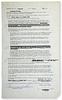 1964. A contract signed by Tennessee Williams that allows publication of his story "Three Players of a Summer Game" in Fifty Best American Short Stories 1915-1965. The story was first published in The New Yorker in 1952 and introduced the characters Brick and Margaret Pollitt, who were featured in the dramatic adaptation, Cat on a Hot Tin Roof, which won the Pulitzer Prize for Drama in 1955. The 1958 film version, with Paul Newman and Elizabeth Taylor as the Pollitts, was nominated for six Academy Awards. Several sections of the contract have been x'd out. Legal-sized paper, folded in fourths. Near fine.
[#036742]
SOLD
1964. A contract signed by Tennessee Williams that allows publication of his story "Three Players of a Summer Game" in Fifty Best American Short Stories 1915-1965. The story was first published in The New Yorker in 1952 and introduced the characters Brick and Margaret Pollitt, who were featured in the dramatic adaptation, Cat on a Hot Tin Roof, which won the Pulitzer Prize for Drama in 1955. The 1958 film version, with Paul Newman and Elizabeth Taylor as the Pollitts, was nominated for six Academy Awards. Several sections of the contract have been x'd out. Legal-sized paper, folded in fourths. Near fine.
[#036742]
SOLD
79.
WOLITZER, Meg
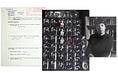 1985-1986. An 11-page author questionnaire submitted by Wolitzer in advance of the publication of her second novel, Hidden Pictures (here briefly called Home Fires before the title is crossed out). "Signed" by the author (as in, Wolitzer has twice printed her name). Her answers are brief, but she supplies demographic information; answers where the idea for the book originated ("From the imagination"); imagines its target market ("People who read serious fiction, plus a feminist/gay audience as well, although I'm sure the two may overlap"); and the special groups that may be interested ("Any gay rights or women's org. I don't know how to get information about them"). She provides a full-page list of notables who should receive galleys. The only correspondence included is a typed note signed by the writer Hilma Wolitzer, Meg's mother, saying how very proud she is of her daughter and that she would like to provide a quote, but "it wouldn't be quite kosher." Included are five original author photos (one by Thomas Victor; four by Jerry Bauer); two contact sheets of photos by Bauer; two printed publicity photos of Wolitzer; and a 1986 press release for Hidden Pictures.
[#036743]
SOLD
1985-1986. An 11-page author questionnaire submitted by Wolitzer in advance of the publication of her second novel, Hidden Pictures (here briefly called Home Fires before the title is crossed out). "Signed" by the author (as in, Wolitzer has twice printed her name). Her answers are brief, but she supplies demographic information; answers where the idea for the book originated ("From the imagination"); imagines its target market ("People who read serious fiction, plus a feminist/gay audience as well, although I'm sure the two may overlap"); and the special groups that may be interested ("Any gay rights or women's org. I don't know how to get information about them"). She provides a full-page list of notables who should receive galleys. The only correspondence included is a typed note signed by the writer Hilma Wolitzer, Meg's mother, saying how very proud she is of her daughter and that she would like to provide a quote, but "it wouldn't be quite kosher." Included are five original author photos (one by Thomas Victor; four by Jerry Bauer); two contact sheets of photos by Bauer; two printed publicity photos of Wolitzer; and a 1986 press release for Hidden Pictures.
[#036743]
SOLD
For notifications of our sale lists, new arrivals, new catalogs, or other e-lists, subscribe to our email list: